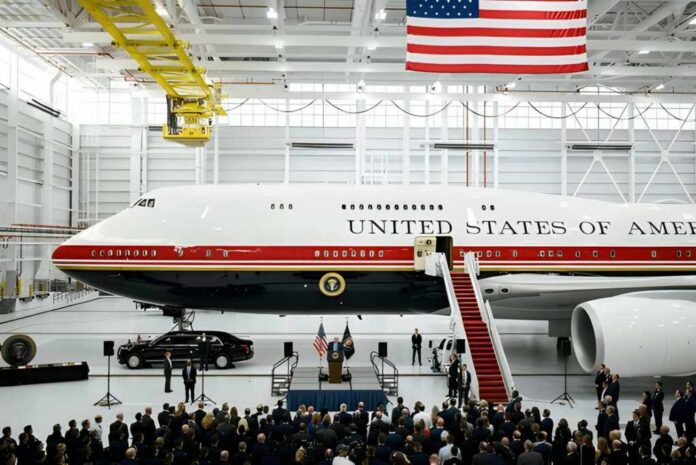
Four New York Times reporters are being hauled before a secret grand jury just days after they exposed security gaps in President Trump’s new Air Force One.
Story Snapshot
- Trump’s Justice Department subpoenaed four New York Times journalists who reported security concerns about the new Qatari-gifted Air Force One.
- The subpoenas force the reporters to testify before a federal grand jury in Manhattan about their sources and reporting.
- No public evidence yet shows these journalists leaked classified information, even as the government cites national security.
- The move fits a growing pattern of the federal government targeting reporters in leak investigations after policy changes that weakened press protections.
What Happened to the New York Times Reporters
The Trump administration’s Justice Department issued subpoenas on Friday to four New York Times journalists who recently wrote about security problems with the new Air Force One. The reporters – Julian E. Barnes, Eric Lipton, Tyler Pager, and Eric Schmitt – are ordered to appear before a federal grand jury in Manhattan on Wednesday. The grand jury is looking into possible leaks tied to the paper’s story on the retrofitted Qatari jet now serving as the president’s main aircraft.
The subpoenas came only two days after the New York Times reported that President Trump left Turkey using the older Air Force One because of security concerns about the newer jet. That story said several officials, informed about the retrofitting process, warned that the new plane lacks some defensive countermeasures and mission capabilities that the old aircraft still has. The report described gaps in electronic defenses and other systems that protect the president when flying near hostile nations like Iran.
What We Know — and Do Not Know — About National Security Claims
The Justice Department argues that forcing the reporters to testify is needed to investigate possible leaks of sensitive or classified information about presidential security. Government officials suggest someone may have revealed protected details about the new Air Force One’s defenses and weaknesses, which they say could help foreign enemies. However, there is no public court filing or statement that names these reporters as the leakers or lists specific classified documents they supposedly exposed.
The original New York Times article said its information came from “several officials informed about the aircraft’s retrofitting process” who asked not to be named, not from stolen documents. The United States Air Force itself admitted that “compromises on some of the less frequently utilized mission capabilities” were made during the retrofit, confirming that at least part of the story reflected acknowledged tradeoffs, not secret leaks. So far, no public evidence shows the reporters had direct access to classified files rather than interviews with officials.
A Growing Pattern: Government vs. the Press in Leak Cases
This clash fits a wider pattern of the federal government ramping up legal pressure on journalists in leak investigations. Earlier this summer, the Justice Department issued, then quietly withdrew, grand jury subpoenas aimed at reporters from the Washington Post and Wall Street Journal over a sealed national security case. Those subpoenas also sought to force journalists to testify about their sources, but media outlets fought back in court and won their withdrawal.
In 2025, the United States Attorney General changed department rules to again allow subpoenas and search warrants against the news media in leak probes, reversing stronger protections put in place under President Biden. That policy made it easier for the Justice Department to demand reporters’ records or testimony when officials claim national security is at risk. Press freedom advocates warn this shift opens the door to routine legal action against journalists, even when the evidence of actual harm is thin or secret.
Why This Alarms People Across the Political Spectrum
Many Americans, both conservative and liberal, already feel the federal government serves powerful insiders first and ordinary citizens last. Seeing four reporters dragged before a secret grand jury for exposing possible weaknesses in Air Force One only deepens that concern. Supporters of the president may worry that real security leaks are being used as an excuse for a broader crackdown on critics. Skeptics of Trump see yet another example of a “weaponized” Justice Department targeting the press.
BREAKING: 🇺🇸🛫The New York times' recently published article about the alleged lack of defensive countermeasures in the new Trump Air Force one that was a gift from the state of Qatar has led to the Trump regime to subpoena the Journalists that wrote the article. pic.twitter.com/xCD2m063WE
— The News Intensity (@Newsintensity) July 11, 2026
Media outlets from the Associated Press to CNN have framed the subpoenas as an attack on press freedom, and the New York Times called them “brazen” pressure on journalists. Civil liberties and press groups argue that forcing reporters to testify about their sources will scare off whistleblowers and hide government failures from the public. At the same time, there is a real worry that elite deals, like the Qatari gift of a $400 million jet and Trump’s foreign business ties, muddy the line between true national security needs and political self‑protection.
What Comes Next for the Case and for Press Freedom
The grand jury in Manhattan will now hear from the four New York Times reporters, unless their lawyers succeed in limiting or blocking the subpoenas. The public may never see full transcripts of their testimony, because grand jury proceedings are usually sealed. Key questions remain unanswered: Did any reporter receive truly classified documents? Did their story reveal details that foreign enemies did not already know from other sources?
Future documents could clarify the picture. A Justice Department affidavit or indictment that clearly spells out which materials were leaked, by whom, and how they endangered security would test the claim that this is about safety, not silence. Without that transparency, many Americans on both the right and the left will likely see this as another sign that a distant federal government uses secrecy and national security language to shield itself from hard questions instead of fixing real problems.
Sources:
washingtontimes.com, apnews.com, facebook.com, x.com, nytimes.com, abcnews.com, koco.com, washingtonpost.com, politico.com, ballardspahr.com, justsecurity.org, pressfreedomtracker.us, justice.gov