The Supreme Court kept postmarked mail ballots alive, and it did so by saying federal law never set a receipt cutoff.
Quick Take
- The Court upheld Mississippi’s rule allowing mail ballots postmarked by Election Day to count if they arrive within five business days.
- Justice Amy Coney Barrett wrote for a 5-4 majority, joined by Chief Justice John Roberts and Justices Sonia Sotomayor, Elena Kagan, and Ketanji Brown Jackson.
- The majority said federal election-day statutes set the day votes must be cast, not the day ballots must be received.
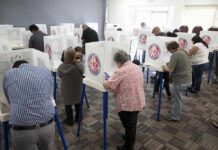
- The ruling matters beyond Mississippi because the Court said roughly 30 states count at least some absentee ballots mailed by Election Day and received later.
What the Court Decided
The Supreme Court ruled that federal election-day laws do not block states from counting timely mailed ballots that arrive after Election Day. The case, Watson v. Republican National Committee, turned on a narrow question: whether a ballot must be in hand by Election Day or only mailed on time. The majority said the statutes require voting by the day itself, not delivery by that day.
The majority also relied on Mississippi law, which allows absentee ballots postmarked by Election Day to arrive within five business days. That detail mattered because it showed how state rules can fill the gap federal law leaves open. The Court said federal law protecting military and overseas voters also points in the same direction, since those voters often depend on mail delays and state receipt windows.
Why the Ruling Matters
The decision protects grace periods in states that use similar rules, and it avoids a fast rewrite of election systems before the next major voting cycle. Groups that support mail voting said the ruling helps voters who face postal delays, disability barriers, or long-distance voting problems. The Court also noted Mississippi is one of roughly 30 states that count at least some absentee ballots received after Election Day.
That larger reach is why the case drew so much attention. Supporters of the ruling see it as a plain reading of federal law and a defense of lawful ballots cast on time. Critics see it as a break from older election practice and a sign that courts are still fighting over what “Election Day” really means. The split reflects a wider national conflict over access, control, and trust in election rules.
The Dissent and the Political Fight
The dissent argued that the decision clashes with two centuries of election-law practice and the usual meaning of Election Day. Justice Samuel Alito, joined by Justices Clarence Thomas, Neil Gorsuch, and Brett Kavanaugh, said the electorate’s choice is not final until all ballots are gathered and counted. That argument gives opponents of late-count rules a clear legal and historical frame, even though the majority rejected it.
.@TomFitton is 100% right to call the Supreme Court’s mail-in ballot decision astonishing.
Justice Barrett and Chief Justice Roberts joining the liberals to allow ballots to be counted after Election Day completely breaks federal law and invites absolute chaos.
Thank goodness… pic.twitter.com/S8NPCqWK9e
— Erica 🇺🇸🇺🇸🇺🇸 (@EricaRN4USA) July 8, 2026
The public reaction was just as divided as the Court. News outlets and advocacy groups on the left called the ruling a win for democracy and for voters who rely on mail ballots. Republicans and President Donald Trump condemned it as a loss, which ensures the decision will keep its place in the larger fight over voting rules, federal power, and who gets to set the pace of American elections.
Sources:
theamericanconservative.com, supremecourt.gov, thearc.org, facebook.com