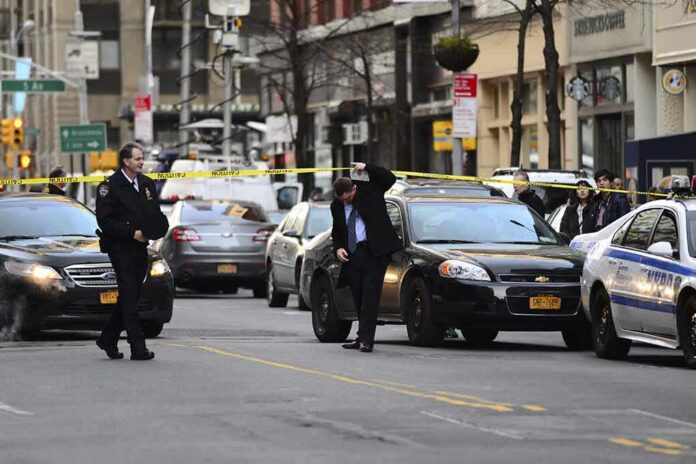
Police say a Queens woman was stabbed to death in her apartment before her boyfriend jumped from their building’s roof as officers arrived.
Story Snapshot
- Police found a 31-year-old woman fatally stabbed inside a Far Rockaway apartment.
- Officers encountered a 33-year-old man on the roof; he jumped and was critically hurt.
- The case is being treated as an intimate-partner homicide, according to police sources.
- City data show many intimate-partner killings had prior police contact in the household.
What Police Say Happened in Far Rockaway
New York Police Department officers responded late Wednesday morning to a building on Neilson Street near Dinsmore Avenue in Far Rockaway. Police sources said they found a blood-covered 33-year-old man standing on the seven-story roof ledge. Officers tried to talk him down. The man jumped and suffered critical injuries. Inside the apartment, investigators found a 31-year-old woman with multiple stab wounds. Police are treating the killing as an intimate-partner homicide tied to a domestic assault.
The New York Daily News reported that officers arrived around 11:50 a.m., and the rooftop encounter followed within minutes. The man’s jump occurred as officers attempted verbal engagement at the scene, according to the report. The woman was identified in other published accounts, which described severe wounds to her face, neck, and body consistent with a violent attack inside the home. Police have not released a full timeline of injuries and recovery status for the suspect.
Why This Case Resonates Citywide
This case reflects how domestic killings often enter public view first through police statements and early reporting. City fatality review data show that from 2014 to 2023, the New York Police Department had documented prior history with victims and perpetrators in about 41% of intimate-partner homicides. In more than a third of those prior-history cases, officers filed only a domestic incident report, not a criminal complaint, which can limit early intervention options and tracking.
Researchers and city reviews note that information on intimate-partner homicides comes from several sources. These include police reports, court filings, medical examiner data, and sometimes news coverage. Each source arrives on a different timeline and with different detail. That lag can leave families and neighbors with partial answers in the first days after a tragedy. It also fuels public concern that systems react after violence, not before it can be stopped.
The Public Safety Tension: Fast Response vs. Prevention
Officers in Far Rockaway faced a split-second crisis on the roof while also needing to secure the crime scene below. Responders must manage immediate threats and preserve evidence that can stand up in court. At the same time, many New Yorkers ask why warning signs do not trigger stronger action earlier. City reviews show prior contact in many cases, yet the follow-up often ends at documentation rather than clear steps to reduce risk in the home.
MAN SURVIVES ROOFTOP JUMP AFTER ALLEGEDLY KILLING GIRLFRIEND
A 32-year-old man survived a rooftop jump after allegedly fatally stabbing his girlfriend, Pheona Premraji, 31, in their Far Rockaway apartment on September 30, according to police and law enforcement sources.… pic.twitter.com/KnVSfGYYV9
— Wick Gone Wild (@WickGoneWILD) October 2, 2026
People across the political spectrum see the same gap. Families want police to move fast when danger rises, and they want a justice system that treats repeat harm as a serious threat. Others emphasize services that help victims leave safely and reach stable housing. Both aims require clear standards, solid data-sharing, and steady funding. When any part breaks down, the public sees scenes like Far Rockaway and wonders why the system did not do more sooner.