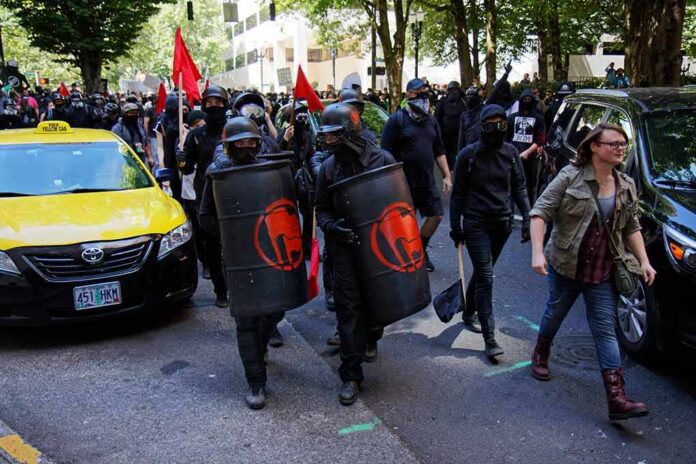
The U.S. government has labeled an Italian tech collective a global terrorist for allegedly running the internet plumbing of Antifa’s most violent cells.
Story Snapshot
- The State Department designated Autistici/Inventati, an Italy-based tech collective, as a Specially Designated Global Terrorist on August 26, 2026.
- Treasury says the group gave “specialized digital architecture, tools, and services” to Antifa cells and other far-left extremists.
- The designation freezes U.S.-based assets and bans Americans from doing business with the group.
- Autistici/Inventati denies the terrorism label, saying it only provides digital self-defense tools for activists since 2001.
- The public record does not show detailed proof tying specific attacks to the group’s services.
Government Names Tech Collective a Terror Entity
The U.S. Department of State announced on August 26, 2026, that it had designated Autistici/Inventati, known as A/I, as a Specially Designated Global Terrorist. The same day, the department released a broader statement titled “Imposing Sanctions on Violent Far-Left Terrorist Groups,” placing A/I inside a larger crackdown on what it calls transnational far-left terrorist networks. The action targets multiple groups at once, not just one entity.
Treasury Spells Out the Legal Theory
The Treasury Department’s Office of Foreign Assets Control said A/I was designated for “having materially assisted, sponsored, or provided financial, material, or technological support for” acts of terrorism. Treasury described A/I as supplying “specialized digital architecture, tools, and services for Antifa cells and other violent far-left extremists.” Secondary reporting ties the group’s services to named entities including Portland’s Rose City Antifa and Masar Badil.
The designation carries real financial teeth. Reporting on the sanctions action says the move bars Americans and U.S. banks from doing business with A/I and freezes any assets that fall under U.S. jurisdiction. Secretary of State Marco Rubio publicly framed the move as part of a fight against what he called a profound threat from far-left terrorism, linking his statement directly to the designation announcement.
Collective Says It Only Offers Digital Self-Defense Tools
Autistici/Inventati pushed back hard. In a press release, the group said it has provided email, hosting, mailing lists, chat, videoconferencing, and streaming services since 2001. It flatly denied the terrorism claims, saying its work is about “digital self-defense” and “free communication for activists.” The group added a blunt line that has spread widely online: antifascism and anticapitalism are not terrorism, and protesting is not terrorism.
What the Public Record Does Not Show
The government’s public releases state a legal conclusion but do not include the evidence behind it. There are no released exhibits, financial transfer records, subscriber logs, or sworn testimony connecting A/I’s services to a specific violent act. The releases also do not explain whether A/I knowingly served violent actors or simply hosted accounts like any internet provider might, without knowledge of how those accounts were used.
No criminal indictment or court judgment against A/I has surfaced in public records. A sanctions designation is an administrative action decided inside the executive branch, not a conviction reached through an open trial. That distinction matters because it means the evidentiary bar clearing this designation has not been tested by a judge, a jury, or cross-examination, unlike a criminal case.
A Pattern Bigger Than One Case
This case fits a growing trend of governments sanctioning the tech layer behind movements, not just the people accused of violence. Treasury’s sanctions rules already cover “material or technological support,” and the government has used similar tools before against cyber infrastructure providers. Legal scholars have long warned that this kind of enforcement often moves faster than public evidence can catch up, raising fairness questions regardless of who is targeted.
𝐒𝐓𝐀𝐓𝐄 𝐃𝐄𝐏𝐓 𝐃𝐄𝐒𝐈𝐆𝐍𝐀𝐓𝐄𝐒 𝐀𝐍𝐓𝐈𝐅𝐀’𝐒 𝐓𝐄𝐂𝐇 𝐁𝐀𝐂𝐊𝐁𝐎𝐍𝐄 𝐀 𝐓𝐄𝐑𝐑𝐎𝐑𝐈𝐒𝐓 𝐄𝐍𝐓𝐈𝐓𝐘—𝐓𝐇𝐄𝐈𝐑 𝐒𝐈𝐓𝐄𝐒 𝐆𝐎 𝐃𝐀𝐑𝐊
The websites went dark within hours. The State Department, working with Treasury Secretary 𝐒𝐜𝐨𝐭𝐭 𝐁𝐞𝐬𝐬𝐞𝐧𝐭,… pic.twitter.com/t746tMVDp5
— M.A. Rothman (@MichaelARothman) August 30, 2026
The fight over A/I is likely to split along familiar lines. Supporters of the designation will call it overdue action against a support network for political violence. Critics, including digital rights groups, will call it a dangerous precedent that punishes infrastructure providers based on secret evidence. Both sides are reacting to the same set of facts: a foreign tech collective has been formally branded a terrorist entity, and the underlying proof remains locked inside the government’s files for now.
Sources:
thegatewaypundit.com, redstate.com, home.treasury.gov, inventati.org, explainx.ai, crimethinc.com