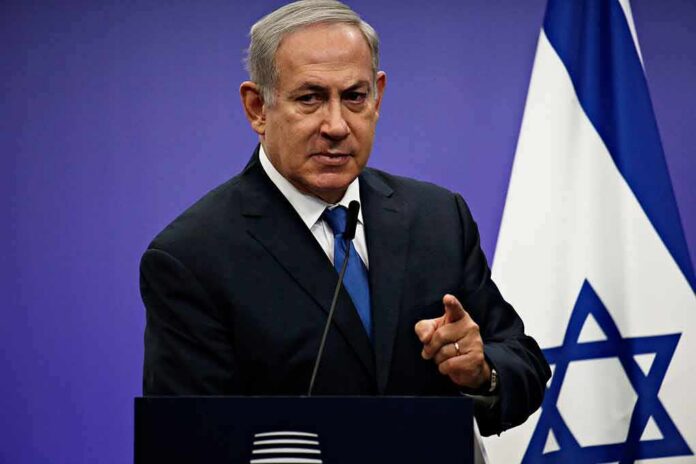
Israel’s prime minister told the United Nations that a “seven-front war” leaves Israel no choice but to win, and he cast the United States as an essential partner in that fight.
Story Highlights
- Benjamin Netanyahu framed Israel’s struggle as existential and vowed, “We’re going to win.”
- Dozens of delegates walked out as he defended strikes in Gaza and Iran and rejected genocide claims.
- Netanyahu listed threats tied to Iran and its allies, describing a multi-front conflict.
- The speech fits a pattern where leaders stress survival to rally support and justify action.
Netanyahu’s Core Message: An Existential Fight Demands Victory
Prime Minister Benjamin Netanyahu used his United Nations address to say Israel faces a fight for survival. He defended military actions in Gaza and against Iran as necessary. He said the cost of stopping would be higher than the cost of pushing on. He ended with a clear pledge: “We’re going to win. We have no other choice.” His words were aimed at allies and critics who question Israel’s strategy and the human toll of the war.
Netanyahu also rejected claims that Israel committed genocide in Gaza. He called the charge “the greatest lie of the century.” He argued Israel’s war is about defense, hostage rescue, and stopping future attacks. He said the military targets are tied to Iran’s network. The speech was tough in tone. It was built to harden support at home and among partners abroad, while pushing back at legal and diplomatic pressure.
A Walkout and a Wider Audience: Why the Room Emptied
Dozens of delegates walked out before and during Netanyahu’s remarks. The walkout showed how divided the world is over Israel’s conduct in Gaza and its strikes involving Iran. It also gave Netanyahu a visible foil. His team likely knew cameras would capture the empty seats. That image helped him argue Israel stands firm even when others turn away. The optics set up a simple story: Israel faces down both armed enemies and hostile diplomacy.
Leaders often lean on survival language in times of high civilian suffering and global criticism. That language raises the political cost of any pause or deal. It also seeks more backing from allies who fear a wider war. Netanyahu’s choice of phrases matched that pattern. The message was sharp, brief, and meant to be quoted. It focused on outcome over process. In short, he asked the world to see the conflict as necessary self-defense, not open-ended escalation.
The “Seven-Front” Frame: Iran-Linked Threats Around Israel
Netanyahu mapped the battlefield as a ring of threats that he tied to Iran. He cited attacks or pressure from Gaza, Lebanon, Syria, Yemen, and militia groups in Iraq. He warned that Iran’s network seeks to wear Israel down over time. He said Israel has hit back across this arc and will keep doing so. The picture he drew was not a single war, but many linked fights. That frame helps explain why he called the stakes existential.
In fiery @UN speech, Netanyahu blasts Iran, Qatar, Turkey, slams Gaza genocide accusation https://t.co/7SPrZvuYJQ via @timesofisrael
— NYCREMilton (@NYCREMilton) September 25, 2026
Netanyahu said past and recent strikes on Iran and its partners were choices made to prevent a larger disaster. In other remarks reported this week and last year, he claimed that attacking Iran was among his “easiest” decisions, because not acting would be worse. That line supports his larger case: delay invites danger, and speed saves lives. Supporters see resolve; critics see risk. But his stance asks allies to measure costs over years, not days.
Why This Matters for Americans
Netanyahu’s speech matters for the United States because it ties Israel’s fate to American power and will. It signals more calls for U.S. diplomatic cover, weapons transfers, and intelligence sharing. It also warns of a longer regional struggle that could touch oil prices, shipping lanes, and troop safety. For many Americans, right and left, this raises a hard question: Is Washington backing a partner to prevent a bigger war, or sliding into one step by step? The answer shapes budgets, energy costs, and security.
American leaders now face the same trust gap many voters see at home. People across the spectrum worry that elites choose endless commitments while families pay the bill. Netanyahu’s stark frame may firm up U.S.-Israel ties, but it also sharpens those concerns. Clear goals, limits, and timelines will be what many Americans look for next. Without them, support can fade. With them, a hard policy can still hold. That is the test for both governments in the months ahead.
Sources:
jns.org, ynetnews.com, bbc.com, dw.com, sbs.com.au