For the first time, the United States and Saudi Arabia have jointly bombed targets inside Iraq in the name of self-defense, raising fresh fears that ordinary people are paying the price while powerful governments trade blows over drones and oil.
Story Snapshot
- U.S. Central Command says U.S. and Saudi jets hit “Iran-aligned terrorists” at logistics and weapons sites across eastern Iraq after over 30 drone attacks in 72 hours.
- Saudi Arabia claims the drones came from Iraqi militias backed by Iran and were aimed at key oil facilities, and says it acted under United Nations self-defense rules.
- The U.S. and Saudi governments have not named the specific Iraqi groups hit or shared public proof tying each site to the exact drone attacks.
- The strikes deepen Iraq’s role as a battleground in the wider U.S.–Iran–Gulf conflict, feeding worries that regular citizens and the rule of law are getting sidelined by powerful states.
What The U.S. And Saudi Governments Say Happened
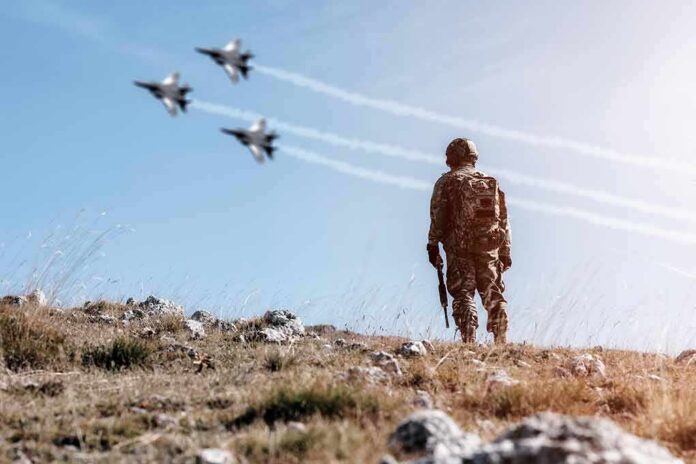
U.S. Central Command, which oversees American military operations in the Middle East, says U.S. and Saudi Arabian fighter jets carried out precision strikes in Iraq on July 28. The targets were described as “terrorist logistics and weapons sites” across eastern Iraq used by “Iran-aligned terrorists” that Iran’s Islamic Revolutionary Guard Corps directed to attack U.S. forces and Saudi energy infrastructure. Central Command said these strikes were a “strong response” to more than 30 drone attacks in the previous 72 hours.
Saudi Arabia’s Ministry of Defense backed up that basic story, saying its forces launched “precise and targeted” strikes in coordination with the United States. Saudi officials said their air defenses had recently intercepted drones aimed at petroleum facilities in the Eastern Province and the Riyadh region, and claimed these drones were launched from Iraqi territory by Iran-aligned militias. The kingdom framed the operation as self-defense under Article 51 of the United Nations Charter and insisted it does not seek wider escalation.
The Evidence Gap And Why It Worries People Across The Spectrum
While both governments agree on the basic facts that joint strikes occurred, they have released very few details that an outsider can check. Neither the U.S. nor Saudi Arabia has publicly named which specific Iraqi groups were hit or provided images, debris analysis, or intercepted communications that tie each damaged site to particular drone attacks. This fits a familiar pattern in the region: officials make strong claims, often backed by classified intelligence, while the public is asked to trust them without seeing much hard proof.
For many Americans, both conservative and liberal, this pattern feels uncomfortably close to past wars where official stories came first and fuller truth arrived much later, if at all. Conservatives who already suspect the “deep state” of dragging the country into endless foreign conflicts see another overseas bombing campaign launched without a clear, public trail of evidence or a fresh vote from Congress. Liberals who worry about human rights and the growing gap between rich and poor see powerful states using force across borders with little transparency about who was killed or how civilians are protected.
Iraq As A Battleground And The Risk To Ordinary People
Iraq once again finds itself used as a battlefield for other countries’ fights, this time between the United States, Iran, and Gulf states like Saudi Arabia. Central Command says that from February through April 2026, there were more than 600 attempted attacks on U.S. citizens and facilities by Iran-aligned militias in Iraq, underscoring how deeply Iraqi soil is now tied to these proxy battles. Regional reporting also shows Iraq-based militias launching drones and rockets toward Saudi Arabia and other Gulf nations in earlier months.
US, Saudi Arabia strike Iran-backed militias in Iraq after attack on American base
CENTCOM says the joint airstrikes targeted weapons and logistics sites after Iran launched ballistic missiles at a US base in Jordan and directed mo…https://t.co/8nmFWtQHs2 pic.twitter.com/KfadsBumEd
— Ynet Global (@ynetnews) July 29, 2026
For Iraqis living near the targeted areas, the labels in foreign press—“terrorist logistics sites,” “Iran-backed militias”—do not change a basic reality: bombs hit their country, and they have little say in it. Some Iraqi armed groups deny involvement in the drone attacks and threaten to retaliate, while past Iraqi governments have often condemned foreign strikes as violations of sovereignty. That cycle makes Iraq less stable, scares away investment, and makes daily life harder for families who just want security, jobs, and a chance at a normal future.
Energy, Drones, And The Sense That Elites Are Playing A Different Game
Saudi officials link the strikes directly to the defense of oil facilities, which power the kingdom’s economy and affect global fuel prices that hit American wallets. At the same time, many citizens across the political spectrum feel they pay the costs of these energy and security battles, while top officials and large companies manage the risks on their own terms. Drone warfare adds another layer: small, relatively cheap weapons can now trigger large military responses, but the public almost never sees detailed proof of who launched them.
This episode taps into a growing shared concern that the federal government and its partners act quickly when energy infrastructure or military assets are threatened, yet move slowly when average Americans struggle with debt, health care costs, or crime at home. People who distrust “woke” agendas see money and focus flowing overseas instead of fixing problems they see on their streets. People angry about inequality see another reminder that oil fields and bases get instant protection while their own communities feel exposed.
What To Watch Next
Several key questions remain. Will the United States or Saudi Arabia release more evidence about the exact groups and facilities they hit, such as satellite images or debris analysis that can be checked by independent experts? Will Iraq’s government issue a clear public statement, either backing or contesting the claims that the strikes were necessary self-defense against militias on Iraqi soil? And will Congress demand more oversight over U.S. military actions that could drag American forces deeper into a wider war with Iran and its allies?
For now, the strikes show how fast powerful states can act when they feel threatened, and how slowly clear answers can arrive for everyone else. That gap—between rapid force and delayed truth—is exactly what many citizens on the left and the right fear when they talk about unaccountable elites and a federal government that seems more focused on managing its own power than on protecting their American Dream.
Sources:
cbsnews.com, reuters.com, fakti.bg, rt.com, wsj.com, shafaq.com, centcom.mil, youtube.com, bbc.com