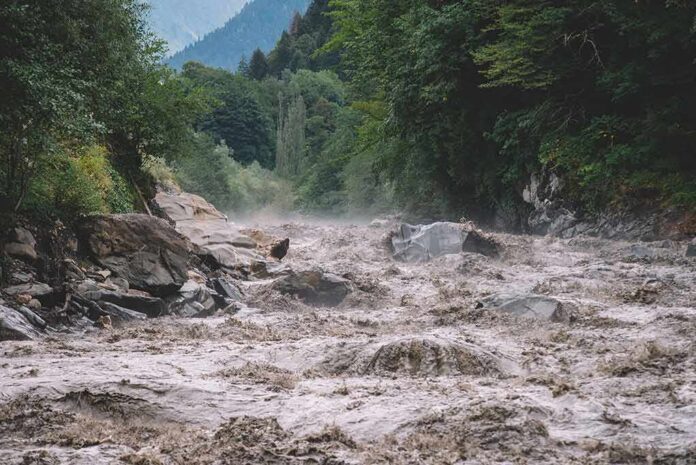
A wall of ice and rock collapsed into a border river and unleashed deadly flash floods across northern Nepal, leaving many dead and hundreds missing.
Story Snapshot
- Authorities report multiple deaths and hundreds missing after sudden floods.
- Nepal says an ice-rock avalanche likely triggered the disaster along the Tibet border.
- Rescuers deployed helicopters and emergency teams; people were told to move uphill.
- Roads, bridges, and power projects were destroyed as search efforts continue.
What Officials Say Happened
Reporters on the ground say a mass of ice and rock fell into a river on the Nepal–China border on Wednesday. That collapse sent a fast surge of water and debris down Nepal’s side. Reuters described it as an ice-rock avalanche that triggered the flash flood and swept away villages and project sites. Other outlets echoed that framing while noting the exact chain is still being reviewed by experts. Casualty figures remain in flux during the response.
The human toll is still being counted. Reuters reported at least nine deaths, while other outlets placed the figure higher. Several hundred people are listed as missing, including tourists and local residents, according to early government briefings cited by broadcast and wire services. Authorities warned that the toll could rise as access improves and rescuers reach isolated settlements. Officials asked people along riverbanks to move to higher ground.
Rescue Operations and Cross-Border Response
Nepal mobilized helicopters, the army, and disaster response teams to search for survivors and clear routes. A government spokesperson said Nepal requested help from both India and China to support rescue efforts in the rugged border terrain. Emergency teams are working on both sides of the frontier, but damaged bridges and blocked roads slow progress. Power projects and local checkpoints suffered heavy hits, adding to communications and logistics problems.
Rescue crews face steep canyons, unstable slopes, and fast water. Commanders are flying reconnaissance to find stranded groups and drop supplies where landing is unsafe. Ground teams are marking safe paths and using hand tools and excavators to open narrow corridors. Officials said more assets will surge as weather and visibility improve. Evacuation centers are taking in families from low-lying areas downstream.
Why These Floods Happen in the Himalayas
Scientists who study the Himalayas warn that sudden mountain floods are a recurring risk. The International Centre for Integrated Mountain Development says many valleys hold unstable glacial lakes and slopes. Ice avalanches, landslides, or lake failures can send walls of water and debris downstream with little warning. Recent studies describe how warming has expanded glacial lakes and exposed communities and infrastructure to higher danger during the monsoon season.
#BREAKING: At least one Australian is feared to be among hundreds of people missing after an avalanche of ice and rock triggered massive flash floods that swept through parts of Nepal. pic.twitter.com/0bpNqfj0uI
— Naqeeb Hussain (@Passdarg) August 26, 2026
Early labels for triggers often change as data arrives. Investigators will review satellite images, sensor records, and eyewitness accounts to map the failure zone and timeline. But for people in the path, the focus now is search and rescue, clean water, and safe shelter. Downstream districts remain on alert as rivers carry debris and pulses. Authorities plan damage checks on roads, bridges, and power sites once waters drop to safer levels.
Sources:
youtube.com, wglt.org, reuters.com, pbs.org