A shallow quake under Italy’s Campi Flegrei supervolcano just sent a cliff crashing down toward parked cars, underscoring how fragile life can be when nature stirs and government systems lag behind.
Story Snapshot
- A magnitude 4.7 earthquake hit the Campi Flegrei volcanic area near Naples, triggering rockfalls and crushing vehicles.
- Scientists say Campi Flegrei has been in a long unrest phase, with rising ground and swarms of shallow quakes under millions of residents.
- The dramatic rockfall clip fits a wider pattern of real damage mixed with poorly verified disaster footage online.
- The Bay of Naples now faces complex linked volcanic risks while people worldwide question whether leaders are truly preparing.
Quake Triggers Rockfall And Panic Near Naples
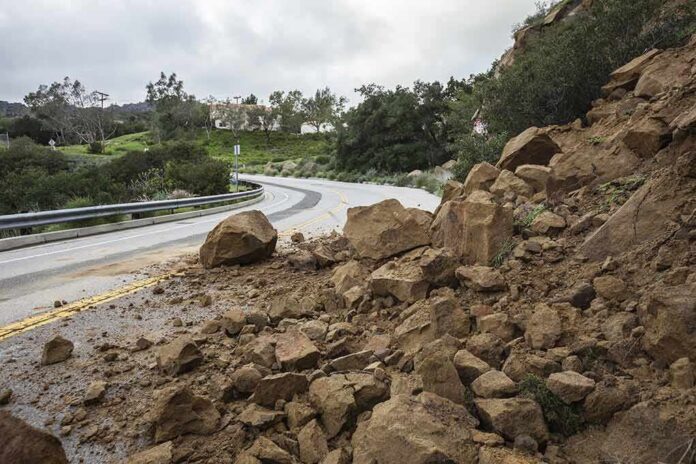
On July 31, a magnitude 4.7 earthquake struck the Campi Flegrei volcanic region west of Naples in southern Italy at about 7:46 p.m. local time, only around three kilometers below the surface. The shaking sent residents running into the streets and caused some buildings to suffer serious structural damage. In nearby areas, large boulders broke loose and crashed down onto parked cars, crushing several vehicles and adding to the sense of chaos and fear. A now-viral clip shows a cliff face giving way as rocks roar toward a road, matching these reported impacts.
Italian and international reports say the quake injured at least dozens of people, cut power in parts of the region, and disrupted local train and metro services. For families who live under the shadow of Campi Flegrei, this was not just another tremor. It was a reminder that the ground under their homes is unstable and that basic safety, transport, and emergency systems can break down in seconds. As videos of the rockfall bounced around social media, people far beyond Italy saw scenes that fed existing worries about crisis readiness worldwide.
Why Campi Flegrei Is So Unstable Right Now
Campi Flegrei is not a typical single-cone volcano but a wide volcanic caldera that sits just west of Naples and under parts of the bay. It is considered one of Europe’s most dangerous volcanic systems because more than a million people live on and around it. Italy’s National Institute of Geophysics and Volcanology reports that since 2005, Campi Flegrei has entered a new phase of ground uplift, with the surface rising about 144 centimeters by April 2025. This uplift is driven by pressure changes in deep hydrothermal and magmatic systems and has come with tens of thousands of earthquakes since 2023.
Scientists studying Campi Flegrei have found that many of these quakes are shallow and occur in swarms, often under the Solfatara and Pisciarelli areas. One 2024 magnitude 4.4 quake near Pozzuoli caused cracks in buildings and frightened residents across Naples. Research in top journals links this ongoing seismicity to rising pressures in a geothermal reservoir, which can weaken rocks and make slopes more likely to fail during shaking. Put simply, the system is under stress, the ground is moving, and steep cliffs and road cuts are more likely to shed rocks when even moderate tremors hit.
The Video Is Realistic, But Clip-Level Proof Is Thin
The circulating rockfall video fits what experts and newsrooms report about this quake: shallow shaking near Campi Flegrei, cliffs giving way, and boulders smashing cars. Similar footage and photos appear in multiple outlets, including segments showing a ridge or cliff collapsing after a swarm of quakes. However, the specific clip discussed here is not backed by direct metadata or an on-record statement from the person who filmed it. There is no public record of the original upload time, GPS location, or a named witness attached to this exact file in the sources provided.
Verification teams point out that this is a common problem in disaster coverage. When a big event hits, many real scenes get filmed, then cut, re-labeled, and shared again for views. Some posts mix older footage from other Campi Flegrei quakes or landslides with new captions about the latest tremor. That does not mean the rockfall did not happen; both Italian civil protection reports and foreign coverage confirm real boulder falls that damaged cars on July 31. It does mean viewers should be cautious about assuming that every dramatic clip online shows the exact moment, place, and cause claimed in its title.
Volcanic Threats, Deep-State Distrust, And Everyday Risk
While people in southern Italy watched cliffs crumble, many Americans saw the footage and asked a wider question: if a supervolcano region in a rich Western country can be this exposed, how prepared are we at home? Campi Flegrei sits near Mount Vesuvius, and studies using satellite radar and seismic imaging suggest the two volcanoes may share deeper pressure or fluid connections at around eight to ten kilometers depth. Other work argues that they still have separate shallow magma chambers, showing how even experts disagree on the exact risk picture.
🌋 Italian authorities continue emergency response after magnitude 4.7 earthquake strikes Campi Flegrei volcanic area near Naples
Officials inspect damaged buildings as 21 people remain injured and hundreds displaced following the area's 'strongest' quake in 40 years… pic.twitter.com/VciQLjSRuZ
— Anadolu English (@anadoluagency) August 1, 2026
That mix of hard science and uncertainty feels familiar. Many on both the right and the left already believe elites hide key data, drag their feet on infrastructure, and focus more on press conferences than on real protection. The Campi Flegrei case does show serious, long-running research and active monitoring by Italy’s observatories. Yet residents still face cracked walls, rockfalls, and fear every time the ground jumps. For viewers in the United States, it is another sign that large systems—whether volcanic, financial, or political—can stay stressed for years while ordinary people are told to trust that “everything is under control.”
What This Means For Ordinary People Watching From Afar
For families near Naples, the lesson is clear: know your evacuation routes, follow local alerts, and push leaders for honest risk maps and stronger building checks. For Americans watching the rockfall clip between stories about inflation, border fights, and energy costs, there is a broader takeaway. Complex threats like supervolcanoes or seismic swarms cannot be fixed with slogans. They demand long-term planning, transparent data, and spending on things that do not win quick elections—like reinforcement of old bridges, retrofits for hospitals, and real emergency drills.
In that sense, the crashing cliff in Italy is more than a dramatic video. It is a blunt picture of what happens when deep natural forces meet shallow human preparation. The science of Campi Flegrei is advanced and growing. Yet even there, rockfalls still crush cars and shake trust. People who already feel that government, big media, and global institutions are more interested in protecting their own power than protecting regular citizens will likely see this event as one more warning. Nature does not care about talking points, and neither will the next quake.
Sources:
youtube.com, euroweeklynews.com, ingv.it, x.com, gfz.de, volcano.si.edu, volcanodiscovery.com, news.cgtn.com, news.stanford.edu, pmc.ncbi.nlm.nih.gov, nature.com, science.org, sustainability.stanford.edu, facebook.com, instagram.com, newsflare.com