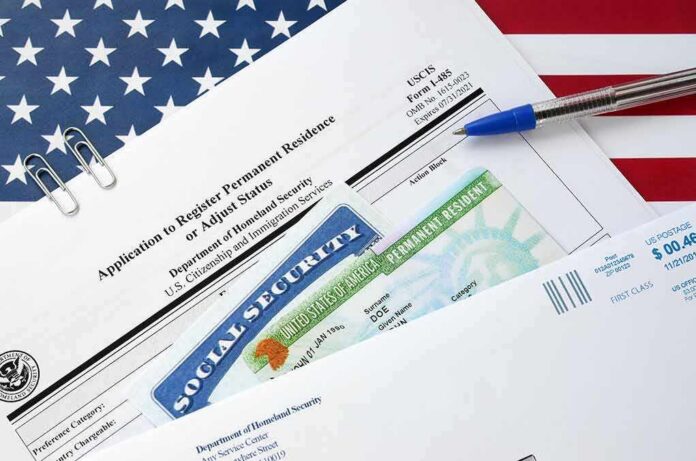
When a federal administration abruptly rewrites immigration rules, states like Connecticut often act as the shock absorbers, using their own treasuries to keep legally present residents from tipping into crisis.
Key Points
- Connecticut Governor Ned Lamont has requested $5 million from the state’s Federal Cuts Response Fund to support residents losing Temporary Protected Status (TPS) work authorization because of federal policy changes.
- The funding is framed as emergency stabilization aid for Connecticut households already living and working in the state, not as a broad new immigration program.
- The money would be administered through the Department of Social Services, plugging gaps created when federal or other state programs cut TPS-related support.
- This move sits in a longer pattern of Connecticut using state funds to offset federal withdrawals for immigrant-serving nonprofits and vulnerable communities.
What Governor Lamont Did and Why It Matters
The central action in this episode is straightforward: Governor Ned Lamont submitted his fifth formal request to tap Connecticut’s relatively new Federal Cuts Response Fund, asking to direct $5 million toward residents affected by changes to federal Temporary Protected Status policy. TPS is a federal designation that allows nationals of certain crisis-stricken countries to live and work legally in the United States without being classified as refugees or permanent residents. When Washington narrows or terminates those designations, people who have been lawfully present for years can suddenly lose their work permits and, in practical terms, their ability to maintain basic stability.
Lamont’s press release explicitly ties the $5 million request to “changes to Temporary Protected Status (TPS), including Haitian, Syrian, and other impacted individuals,” underscoring that the target population is residents who had lawful TPS-based status until the Trump administration moved to end or scale back those protections. In parallel social media statements, he described “thousands of Connecticut residents” losing work authorization and legal status, and asked legislative leaders to approve this draw on the fund to help them navigate that sudden loss. The policy logic is not subtle: if federal decisions strip away TPS protections, Connecticut will deploy state dollars to cushion the landing for affected households.
The Federal Cuts Response Fund: A State Shock-Absorber
Connecticut’s Federal Cuts Response Fund is the mechanism that makes this move possible. Created in 2025 by Lamont and the General Assembly, the fund was designed as a standing reserve to deal with “significant federal policy and funding changes affecting Connecticut residents, businesses, and communities.” Rather than scrambling to pass bespoke emergency appropriations every time Washington changes course, the state pre-committed a pool of money that the governor can propose using, with legislative leaders holding veto power.
By the time of this fifth request, four earlier proposals to tap the fund had already been approved “without objection” by legislative leaders, suggesting a working consensus that some federal shocks warrant state backstopping. After the proposed $5 million TPS allocation, roughly $262.5 million would still remain in the fund for future uses. That context matters for taxpayers: the TPS support is not an open-ended blank check but a discrete slice of a larger reserve, with formal procedures and political oversight governing every draw.
Who TPS Holders Are and What Is Changing
Temporary Protected Status sits in a narrow, specialized corner of immigration law. The Department of Homeland Security grants TPS to nationals of countries experiencing armed conflict, environmental disaster, or other extraordinary conditions that make safe return impossible. TPS does not put recipients on a path to citizenship; instead, it provides time-limited protection from removal and eligibility for work authorization so they can support themselves while conditions in their home country are assessed.
Connecticut’s TPS population includes Haitians, Syrians, and other nationals from designated countries, many of whom have spent years in the state working, paying taxes, and raising families. Lamont’s communications around the $5 million request repeatedly highlight Haitians and Syrians as emblematic cases. When the Trump administration moved to terminate TPS designations for several countries or decline renewals, those residents’ work permits were scheduled to expire, sometimes within weeks. For a household built around TPS-based income, that is not a theoretical concern; it means an imminent disruption to rent payments, food budgets, and the ability to stay in good standing with landlords and creditors.
How the $5 Million Is Intended to Be Used
The proposed $5 million would be administered by the Connecticut Department of Social Services (DSS), the agency that already serves as the principal allocator for various community services and block grant programs. Lamont’s release describes the money as helping eligible individuals “access critical services and maintain stability” as they navigate federal policy changes. In practice, that typically involves a mix of case management, limited cash or in-kind assistance, referrals to legal services, and coordination with nonprofit organizations that specialize in immigrant and refugee support.
Although the detailed allocation plan for this specific TPS tranche is not spelled out line by line in the governor’s release, recent history offers a clear template. In prior episodes, Lamont signed legislation or struck budget deals directing several million dollars to nonprofits like the Connecticut Institute for Refugees and Immigrants (CIRI), Integrated Refugee & Immigrant Services (IRIS), and health and LGBTQ organizations after federal funding was frozen or cut. Those dollars flowed as grants to agencies that already had the staff, trust, and infrastructure to serve immigrant and refugee communities. DSS, in turn, ensured that the spending complied with state rules and targeted the intended populations.
Continuity, Not Novelty: Connecticut’s Longstanding Immigrant Support Lane
For critics, the TPS allocation reads as “millions in taxpayer cash for TPS aliens.” For policy analysts, it looks more like the latest installment in a decade-long evolution of state-level immigrant support financing. Connecticut has allowed in-state tuition access regardless of immigration status at public postsecondary institutions, has set up dedicated resources for undocumented students seeking financial aid, and has maintained state-funded benefit programs that are legally accessible to certain categories of immigrant survivors and refugees under defined conditions. Those decisions collectively reflect a governing posture that treats long-term residents as part of the state’s community regardless of their federal status.
Beyond Connecticut, broader research on state Department of Social Services immigration programs shows that states have, for years, provided specific allocations for TPS-related services and then had to reconsider those commitments as budgets tighten or federal priorities shift. One such analysis documents a sustained $10 million annual line for TPS immigration services that was later eliminated in a governor’s budget proposal, even as base immigration services continued. That trajectory—dedicated TPS funding, followed by retrenchment or reconfiguration—mirrors the logic behind Connecticut’s Federal Cuts Response Fund: states need an adaptable tool to respond selectively when federal or intra-state decisions create unacceptable collateral damage for particular groups.
As Gov. Ned Lamont announced on Wednesday that he would direct $5 million to aid immigrants impacted by the loss of Temporary Protected Status (TPS), New Haven’s own refugee resettlement organization is amping up efforts to support as many Haitian immigrants as possible.…
— New Haven Indy (@newhavenindy) July 30, 2026
Politics, Public Perception, and the “Taxpayer Money” Debate
The loudest objections to Lamont’s $5 million TPS proposal are not about the mechanics of the fund but about whom it serves. Social media posts and advocacy campaigns frame the move as “giving taxpayer dollars to TPS holders” or “millions to illegals and people who shouldn’t be here,” often in proximity to unrelated tragedies like the killing of a police officer. This rhetorical strategy taps into a broader national narrative: that any money directed to noncitizens or people with tenuous federal status is inherently unfair to citizens and a misuse of public funds.
The legal and fiscal picture is more complicated. TPS holders were, until the federal changes, authorized to live and work in the United States lawfully. They pay state taxes directly through income and sales taxes and indirectly through rent and utility bills. When their status is revoked, their presence does not vanish; rather, their capacity to support themselves diminishes. The state must then decide whether to absorb some of the shock to prevent cascading social costs—from homelessness and uncompensated emergency care to school disruptions and local economic strain—or to leave the households to manage alone and address the downstream impacts later in costlier ways.
This is the core divide in state-level immigration debates: one governing logic prioritizes fiscal restraint and a clear distinction between citizens and noncitizens in program eligibility; the other stresses service continuity and local responsibility for residents who are already embedded in communities.[Lens 1–2] Connecticut’s repeated use of the Federal Cuts Response Fund for immigrants, refugees, and nonprofits touches that nerve directly. Yet the mechanism itself is bounded, subject to bipartisan leadership review, and funded within the broader constraints of the state budget and spending cap discussions.
The Trust Act and Connecticut’s Broader Stance Toward Federal Immigration Enforcement
The TPS funding decision also sits against the backdrop of Connecticut’s “Trust Act,” a law designed to limit the state’s participation in certain federal immigration enforcement activities. Lamont has defended the Trust Act on constitutional grounds, arguing publicly that “the federal government cannot compel states to use their own resources to carry out federal enforcement responsibilities.” In that framework, the state’s role is not to police immigration status but to decide how its own dollars and institutions respond to the people living within its borders.
Directing $5 million to TPS-affected residents through DSS is consistent with that broader stance. The state is not attempting to override federal immigration determinations; it is accepting them as given and then making a choice about how much social and economic dislocation it is willing to tolerate among families who, until recently, were here under color of federal law. Critics can reasonably argue about priorities—whether those funds should go instead to other needs such as special education, public safety, or tax relief—but the decision is not an act of defiance against federal authority. It is an exercise of state discretion in the face of federal withdrawal.
What This Signals for the Future
From a long-term vantage point, the $5 million TPS proposal is less remarkable as a one-off controversy than as another data point in how states manage federal volatility. The creation and repeated use of the Federal Cuts Response Fund suggests that Connecticut expects more shocks—whether in immigration, health care, education, or other domains—and wants a structurally sound way to respond without inventing ad hoc fixes each time. The choice to prioritize TPS-affected residents in this round reveals that, for this administration, the human costs of abrupt status changes rank high enough to justify a notable allocation.
For residents, the immediate stakes are tangible: the difference between having structured assistance as work permits lapse versus facing the transition alone. For taxpayers, the question is whether using a small slice of a dedicated contingency fund to prevent larger downstream costs represents prudent stewardship or mission creep. That debate will continue as subsequent governors and legislatures decide how—and for whom—to deploy the hundreds of millions still in the Federal Cuts Response Fund. But the logic of the current proposal is clear: when the federal government pulls a support out from under people who have been legally living and working in Connecticut, the state is prepared to step in, at least in part, to steady them.
Sources:
pjmedia.com, portal.ct.gov, lao.ca.gov, cga.ct.gov, facebook.com, ctstate.edu, niwaplibrary.wcl.american.edu