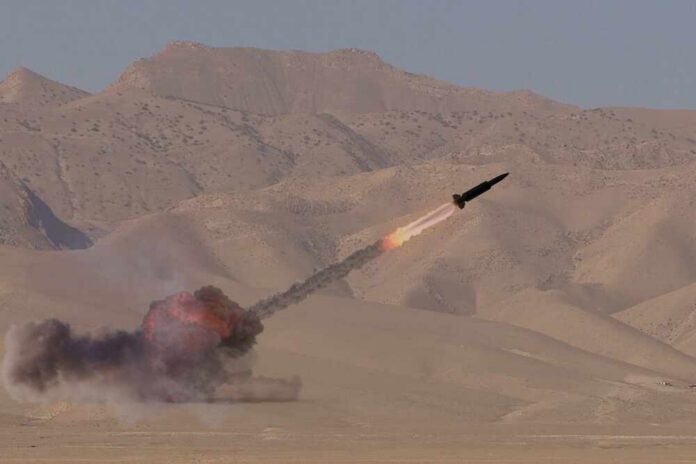
Iran’s Revolutionary Guard says it fired missiles and drones at a United States base in Jordan, then claimed it destroyed fighter jets, tankers, and a command center.
Quick Take
- The Islamic Revolutionary Guard Corps said it struck Al-Azraq Air Base in Jordan with ballistic missiles and drones.
- The group claimed it hit F-35, F-15, F-16, and F-18 aircraft, plus a command center and shelters.
- Jordan said it intercepted incoming missiles, and early reporting did not confirm the damage claims.
- The strike fits a wider wave of Iran attacks and counterstrikes across the region.
What Iran Claimed
The Islamic Revolutionary Guard Corps said it carried out a strike on Al-Azraq Air Base, also known as Muwaffaq Salti Air Base, in northern Jordan. Reporting on the statement says Iran claimed the attack used 10 to 12 ballistic missiles and also included drones. The Guard said the target set included American fighter jets, tanker aircraft, a command center, and support shelters.
Iran’s public message was blunt. The Guard described the strike as retaliation for United States attacks on Iranian targets. It also said the damage was severe, with destroyed facilities and aircraft. That claim matters because it was presented as proof that Iran could hit a major base used by American forces far outside its own borders.
Jordan’s Response
Jordan said its air defenses intercepted incoming missiles, and one report said twenty were shot down without casualties or damage. Other reporting from the same day said Jordan later reported eight missiles intercepted. Those details show why the battlefield claims remain hard to verify in real time. Missile volleys can be launched toward a target, yet still be stopped before hitting what the attacker says it hit.
The gap between the Iranian claim and the Jordanian account is central to this story. Iran’s announcement framed the strike as a success against American hardware. Jordan’s account focused on interception and the lack of confirmed harm. That leaves the most dramatic parts of the Iranian statement unproven by the reporting available so far.
Why This Strike Matters
The attack lands in a larger pattern of regional escalation, where Iran has paired missile launches with broad claims of damage against United States-linked sites in Jordan, Kuwait, and Bahrain. Earlier reporting on this cycle also noted that Jordan has repeatedly intercepted missiles and drones aimed at its airspace. The result is a fast-moving information fight, not just a military one.
Iran has claimed it inflicted “serious damage” on US military assets in Jordan, alleging that a missile and drone strike on the Al-Azraq air base destroyed or severely damaged several American fighter jets, tanker aircraft, and drones. Claim comes amid escalating tensions between… pic.twitter.com/iWwQZVqy9C
— Orissa POST Live (@OrissaPOSTLive) July 17, 2026
That matters for readers because both sides can use the chaos. Iran can try to project strength. Washington and its allies can try to limit the political effect of the strikes. In that kind of fight, bold claims spread faster than hard proof. The pattern adds to public distrust on all sides, especially when military statements arrive before independent damage checks.
What Can Be Said With Confidence
What the reporting supports is narrower than what Iran claimed. The Guard said it targeted a United States base in Jordan with ballistic missiles and drones. Jordan said it intercepted missiles and reported no casualties or damage in the immediate aftermath. Independent reporting quoted here does not confirm the destruction of fighter jets, refueling aircraft, or command facilities.
That makes the core fact clear: Iran announced a direct strike on a key American-linked air base in Jordan, and the claim triggered another round of regional tension. The open question is not whether Iran issued the threat. It is how much, if any, physical damage the attack actually caused.
Sources:
insiderpaper.com, iranintl.com, middleeastmonitor.com, trtworld.com, aninews.in, arabtimesonline.com, economictimes.indiatimes.com, english.news.cn, wanaen.com, youtube.com, facebook.com, aljazeera.com