When the nation’s top spy chief suddenly walks away in the middle of global crises, Americans are left wondering whether this is really about family — or about a system in Washington that keeps breaking the people we send there to fix it.
Story Snapshot
- Tulsi Gabbard is resigning as director of national intelligence, citing her husband’s rare bone cancer and stepping down June 30, 2026.[3]
- President Trump publicly backed her explanation and praised her performance while naming deputy Aaron Lucas as acting director.[4]
- Her exit follows months of controversy, including public clashes over Iran policy and organized campaigns demanding her removal.[2][3]
- The lack of hard documentation on motives leaves a familiar pattern: officials give personal reasons while Americans suspect deeper political and institutional failures.[3][4]
What Gabbard Said, What Trump Confirmed, and the Official Story
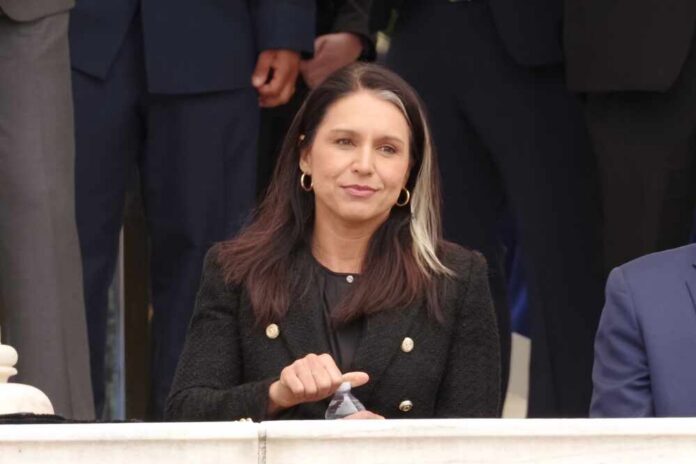
Director of National Intelligence Tulsi Gabbard announced on May 22 that she will leave the post on June 30, telling the country she must step away because her husband Abraham has been diagnosed with a rare form of bone cancer.[3] Her public letter, quoted by multiple outlets, says she cannot in good conscience remain in such a demanding job while he faces major medical challenges and that she needs to be by his side during treatment.[3] President Donald Trump publicly echoed that explanation, praising her service and confirming the June 30 effective date. The Office of the Director of National Intelligence leadership page reflects the announced transition and identifies her principal deputy, Aaron Lucas, as the acting successor who will take over the sprawling intelligence apparatus after she departs.[4]
Television coverage across networks repeated the same basic facts, underscoring how quickly a single narrative can harden in modern media.[3] Broadcasters described Gabbard as having served about a year and a half in the role and framed the exit as her personal decision rather than a firing.[3] Reports emphasized that she will stay on through the end of June, which fits the pattern of a negotiated, orderly transition rather than an overnight purge or scandal-driven dismissal.[4] At the same time, the evidence available so far does not include the full text of her signed resignation letter or independent medical documentation of her husband’s illness, leaving the public reliant on summaries filtered through media and official statements.[3] That information gap feeds a wider skepticism many Americans already have about how honestly Washington explains personnel shakeups at the top.
Political Pressure, Policy Fights, and Why Many Suspect More
Even as Gabbard and Trump presented a united front centered on family, her time as intelligence chief did not unfold in a political vacuum.[3] Coverage from at least one major outlet highlighted that her tenure had been “rocky,” pointing to public disagreement over Iran following the 2025 “Midnight Hammer” operation.[3] In Senate testimony, she was reported to have said Iran’s nuclear enrichment capability had been “obliterated” and that there had been no effort to rebuild, a description that clashed with more alarmed rhetoric coming from other parts of the administration and Congress.[3] Outside the White House, Representative Sydney Kamlager-Dove led a group of Congressional Black Caucus members in a formal call for Gabbard’s resignation, accusing her of endangering national security and demanding she step aside.[2] Progressive activists amplified similar arguments in online campaigns, branding her “incompetent” and urging constituents to pressure Congress to push her out of the job. Separate reporting suggested Trump had privately asked advisers about replacing her even before the resignation announcement, fueling speculation that the relationship had become strained behind closed doors.
None of these political threads, on their own, prove that Gabbard was forced out or that her husband’s illness is a cover story.[3] The record available now does not include any memo, email, or on-the-record statement from Gabbard or Trump saying she resigned because of foreign policy disputes or internal power struggles.[3] At the same time, Side B of the evidence—commentary and analysis around her exit—shows how quickly analysts on all sides framed the departure as part of a larger fight between “America First” isolationists and more traditional national security hawks inside the administration.[3] One prominent discussion portrayed Gabbard as an anti-war voice increasingly marginalized since the Iran conflict, arguing her wing of the movement was losing influence over intelligence and foreign policy.[3] For Americans watching from outside the Beltway, the pattern is uncomfortably familiar: a senior official leaves under the banner of “family reasons” while a storm of unresolved policy battles swirls just beneath the surface, and the public is asked to accept that everything is fine without seeing the underlying documents.[3][4]
Why This Resignation Feeds Broader Distrust in Washington
The way Gabbard’s exit is unfolding reveals as much about the health of American institutions as it does about one official’s personal tragedy.[4] On one side, basic human decency says a spouse should be able to step back when a loved one faces a devastating diagnosis, and nothing in the record directly contradicts that she is doing exactly that.[3] On the other side, systemic habits in Washington make it hard for ordinary citizens to know when they are hearing the full story, especially in national security roles shrouded in secrecy.[4] The White House and the intelligence community can confirm dates and titles while keeping internal deliberations and personnel files locked away, meaning the public must rely on leaks, pundits, and carefully crafted statements. That vacuum reinforces a growing belief across both the right and the left that the “deep state” and political class play by their own rules and are never fully transparent when power changes hands at the top.
Adam Schiff is catching heat for his tone-deaf attack on Tulsi Gabbard moments after she stepped down to support her cancer-stricken husband. Schiff claimed her resignation was her only positive contribution to our national security. pic.twitter.com/d0uxLXlyYp
— Mike Bales 🫡🇺🇸 (@MikeBales) May 23, 2026
Conservatives who already distrust the intelligence bureaucracy after years of politicized investigations see Gabbard’s departure as another reminder that any official who challenges the prevailing narrative—on Iran or anything else—can be sidelined without a clear accounting of why.[3] Liberals who have criticized Trump’s national security decisions see this as one more sign that serious strategic disagreements are hidden behind sanitized talking points instead of debated openly.[2][3] Both sides share a deeper frustration: when leaders leave, the people are rarely told enough to judge whether their government is being run competently, honestly, or in line with the Constitution and common sense.[4] Until more primary documents are released—her full letter, internal communications, and a clearer record of the policy disputes—Americans will be left reading between the lines, trying to piece together what really happened from partial information. That uncertainty is not just about Tulsi Gabbard. It is about a federal government that keeps asking for trust while giving the public fewer and fewer reasons to extend it.
Sources:
[2] Web – Kamlager-Dove Leads Members of the CBC in Calling for DNI Tulsi …
[3] YouTube – BREAKING: Tulsi Gabbard resigns as director of national intelligence
[4] Web – Director of National Intelligence – ODNI