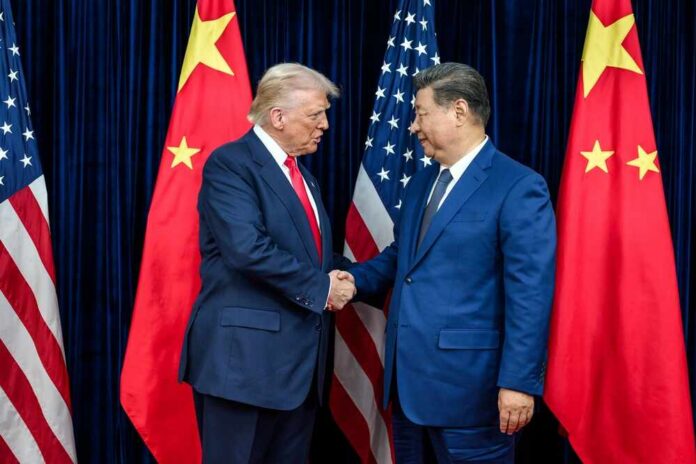
China and the United States have eased tariffs again, but the deal looks more like a timed pressure valve than a real reset.
Quick Take
- The White House says the United States and China reached an economic arrangement that keeps tariff relief in place through November 10, 2026 [4].
- Officials described the move as reciprocal, with both sides suspending or removing some retaliatory measures [4].
- Recent reporting says the tariff cut was substantial, with U.S. duties on Chinese goods falling from 145 percent to 30 percent for the truce period [1].
- Analysts still call the agreement tactical and fragile, not a full settlement of the trade conflict [2][4].
Tariff Relief Comes With a Clock
The White House said the United States and China reached a “historic and monumental deal” that extends the suspension of heightened reciprocal tariffs until November 10, 2026 [4]. That matters because it shows the two biggest economies are still trying to manage a trade war rather than end it. For businesses, the main question is not whether tariffs moved lower, but whether this pause can survive the next round of political and economic pressure.
Broadcast reporting on the May tariff truce said the United States cut its rate on Chinese goods by 115 percentage points to 30 percent, while China lowered its rate on U.S. goods to 10 percent [1]. That is a real shift, but it is also temporary by design. The same reporting said negotiators would spend the next 90 days talking while the lower rates stayed in place, which reinforces the sense of a cease-fire, not a peace treaty [1].
What Each Side Gave Up
The White House order says China committed to suspend or remove many retaliatory actions against the United States, while Washington kept its own tariff suspension in force [4]. Coface reports that the arrangement also includes a pause on some port charges and a one-year delay in certain rare-earth and export-control steps [2]. Those moves matter because they show the agreement runs in both directions. Neither side is simply yielding; both are buying time and reducing immediate friction.
That is why the deal may calm markets without settling the deeper fight. Coface calls it a tactical agreement and says it remains fragile, with semiconductors, rare earths, and export controls still unresolved [2]. The broader pattern fits past U.S.-China trade behavior: tariff spikes, short pauses, and then new rounds of bargaining. The hard truth for exporters, importers, and consumers is that the underlying rivalry still hangs over every concession.
Why Skepticism Still Runs Deep
Bloomberg reporting noted that China had previously promised major soybean purchases and did not fully deliver, which helps explain why new agricultural commitments are being met with caution [1]. Supporters of tougher trade policy see it as proof that Beijing should be pressured, while critics of the administration worry that another headline-grabbing deal may not change daily costs or long-term supply risks. Both reactions are rooted in past experience, not speculation.
The available record does not prove the tariff cuts will lower prices for American families or restore trust in the relationship [1][2][4]. It does show something narrower: both governments found it useful to back away from the edge for now. For a public tired of runaway costs, shaky supply chains, and political theater, that may feel more like damage control than leadership. Still, even a limited pause can matter when the alternative is another tariff spiral.
Sources:
[1] YouTube – US and China agree to significant tariff reductions in 90-day trade …
[2] Web – US-China tactical deal: Tariffs, tech, and rare earths | Coface
[4] Web – Modifying Reciprocal Tariff Rates Consistent with the Economic and …