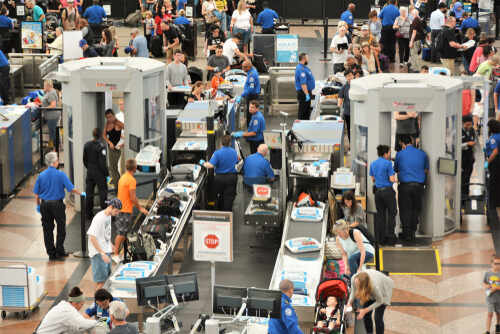
After Washington left TSA officers working for weeks without pay, President Trump is sending ICE agents into airports—forcing a showdown over basic government responsibility and border security.
Quick Take
- President Trump said ICE agents will deploy to U.S. airports starting Monday to help strained TSA checkpoints during a DHS funding standoff.
- TSA officers have reportedly gone more than a month without pay, while major airports have seen severe staffing shortfalls and long security lines.
- More than 400 TSA employees have reportedly quit as absences and resignations worsen the backlog for travelers.
- Senate Democrats pushed a pathway to fund TSA and other functions separately, while Republicans rejected carve-outs tied to immigration demands.
ICE Deployment Begins as Airport Lines Signal a System Under Stress
President Donald Trump announced that Immigration and Customs Enforcement agents will head to airports nationwide beginning Monday to assist Transportation Security Administration operations amid a partial shutdown and a broader Department of Homeland Security funding dispute. The move follows reports of long security lines and staffing breakdowns at large hubs, where travelers have faced delays measured in hours. Trump framed the deployment as a practical response to keep airport security moving while funding remains unresolved.
Operational pressure has been building for weeks. TSA officers, designated “essential,” have continued reporting to work despite going without pay during the funding lapse. Airports including Houston, Atlanta, New Orleans, and Philadelphia have been listed among the hardest hit, with some security waits exceeding three hours. Video from Philadelphia showed crowds stacked at chokepoints near escalators and elevators leading to screening areas.
The Funding Standoff: TSA Paychecks Become a Political Bargaining Chip
The immediate trigger is a stalemate over DHS funding. The provided research describes Democrats holding up DHS funding in an effort to secure immigration policy concessions, while Republicans have opposed separating TSA funding from the larger dispute. Senate Democrats attempted an unusual Saturday legislative push to address TSA staffing and funding pressures, including a procedural effort aimed at funding TSA and select agencies without broader immigration provisions—an approach Republicans rejected.
For conservative voters, the underlying issue is less about parliamentary maneuvering and more about priorities: airport security is not optional, and neither is paying the people required to show up. The research also notes a private-sector offer from Elon Musk to cover TSA salaries during the impasse, underscoring how extraordinary the breakdown has become. Even with outside offers, the constitutional reality remains that Congress controls the purse strings—and dysfunction has real consequences.
What ICE Can—and Can’t—Do at the Checkpoint
The research characterizes the deployment as unprecedented: immigration enforcement personnel stepping into an airport security support role. What that means in practice is still unclear, because the specific operational assignments for ICE agents at checkpoints have not been fully detailed. ICE agents are trained federal law enforcement officers, but TSA screening is a specialized function with its own procedures, compliance requirements, and passenger-flow systems.
Democratic Rep. Jimmy Gomez raised concerns that ICE and CBP personnel are not trained for TSA-style work and warned about the risk of racial profiling. Those criticisms highlight a legitimate question any administration should answer: how will DHS ensure ICE support is integrated without confusing roles, slowing screening, or misapplying authority? At the same time, the staffing crisis documented in the research—mass call-outs, resignations, and multi-hour lines—makes some form of surge capacity a practical necessity.
Travelers and TSA Workers Bear the Cost of Washington’s Stalemate
Thousands of travelers absorbing the fallout in real time, with growing uncertainty about whether they can reach gates on time. Interviews referenced from local reporting also stressed the basic fairness problem: workers cannot reliably cover bills and groceries if pay is delayed for a month or more. That pressure can quickly translate into absenteeism and resignations, creating a cycle where fewer officers produce longer lines, which then strain remaining staff further.
The research states that more than 400 TSA employees have quit during the standoff, alongside widespread absenteeism. If accurate, that is not just a short-term inconvenience; it is an erosion of institutional capacity. Rebuilding an experienced workforce takes time, and constant political brinkmanship can turn “essential services” into a revolving door. Limited public detail is available so far about how long ICE will remain deployed or what metrics DHS will use to measure success.
The broader takeaway is straightforward: when Congress fails to fund core federal responsibilities, Americans do not experience it as an abstract budget fight—they experience it in the security line with a boarding time approaching. Trump’s decision to deploy ICE is being presented as a stopgap to keep airports functioning and to increase pressure for a DHS funding deal. The next test is whether lawmakers restore pay stability and staffing before temporary fixes become the new normal.
Sources:
https://simpleflying.com/president-trump-replace-tsa-officers-ice-if-dhs-funding-continues/