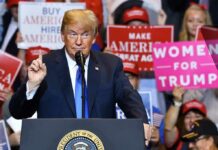
President Trump’s sudden ban on CNN, MS NOW, and Politico from White House access spotlights a direct clash between government power and press rights that could set a fresh legal test for everyone watching the country’s guardrails.
Story Snapshot
- Trump announced an immediate ban on three outlets, citing “fake news.”
- Named outlets and alleged reasons were posted publicly by Trump.
- Legal fights over viewpoint-based press access set the backdrop.
- Scope and implementation details remain unclear in reports.
What Trump Announced And How He Framed It
President Trump said he is banning CNN, MS NOW, and Politico from the White House “effective immediately,” accusing them of constant “fake news” reporting. Reports quote him naming each outlet and promising more bans could follow. He also claimed Politico benefited from government money, though documentation of that payment was not provided in the reports. These statements placed the dispute squarely on the outlet’s coverage, not on a stated violation of a written access policy.
Multiple outlets recorded the announcement as a direct response to coverage Trump dislikes. Time and other reports framed the move as a new test of First Amendment protections for a free press. That framing will shape public reaction across the spectrum. Supporters may see a stand against biased reporting. Critics may view it as punishing disfavored speech by blocking access. Both sides see high stakes for accountability and public trust.
What Is Known And What Is Still Unclear
Reports do not include a formal White House order or a credential revocation notice. That leaves uncertainty about the ban’s mechanics. One station’s report said Trump did not define whether credentials, briefings, or event access are affected. Without written rules or an implementation memo, it is hard to confirm the exact limits. That gap also fuels claims that the move is arbitrary and viewpoint-based. Clear, public standards would reduce ambiguity and the risk of uneven enforcement.
CNN said it stands behind its White House reporters and called the threatened or imposed ban an unconstitutional limit on press freedom. Reuters described the action as a crackdown on the independent press that may conflict with the First Amendment. These reactions preview possible litigation. Courts have often weighed whether the government may restrict access due to space or security while blocking viewpoint punishment. That line will likely define the next phase.
The Legal Backdrop: Recent Access Fights Guide The Stakes
Recent courtroom fights over press access give a roadmap for this clash. In litigation over Associated Press access, a federal court held that once the government opens certain restricted spaces to the press, it cannot exclude a journalist based on viewpoint. That decision emphasized that viewpoint neutrality is required when the government allows some journalists into nonpublic forums like select White House venues. The principle speaks directly to bans tied to coverage labels like “fake news.”
Donald Trump has barred MS NOW, CNN, and Politico from the White House, explicitly stating it is for negative coverage.
I'm old enough to remember when the folks on the right were screaming about "censorship" because privately owned social media companies banned Trump for…
— Machine Pun Kelly 🇺🇦 (@KellyScaletta) September 19, 2026
That said, courts also allow reasonable, viewpoint-neutral limits in tight spaces. The key question is why a specific outlet is excluded. If the reason is space or conduct, that is one debate. If the reason is coverage content, that is another debate with higher constitutional risk. Trump’s public rationale focused on alleged “fake news.” That framing could weigh heavily if a lawsuit seeks an injunction restoring access for the named outlets.
Why This Matters Beyond The Beltway
Americans across the political spectrum are tired of spin and power plays. Many believe government and big media both fail to tell the full truth or fix real problems. This fight taps that anger. Some cheer the ban as overdue pushback against biased coverage. Others fear it is a warning sign: leaders using access to reward friends and punish critics. Either way, limits that hinge on viewpoint risk weakening a core check on power when many already think the system serves elites.
Clear rules can help. A written, public access policy that is viewpoint-neutral and consistently applied would reduce confusion and curb abuse. It would also show whether any exclusion is about standards, not speech. Without that, each move will be read as raw politics. That deepens mistrust at a time when families face rising costs, security worries, and a widening gap between leaders and the people who sent them to Washington to serve, not to settle scores.
What To Watch Next
Watch for a formal directive from the White House or the United States Secret Service that defines the ban’s scope. Look for rapid legal filings by the affected outlets seeking emergency relief. Expect courts to revisit the recent Associated Press logic on viewpoint neutrality. Also watch for documentation on the Politico funding claim, since hard records would shape public judgment on whether taxpayer money influenced coverage or whether the charge was misplaced.
Sources:
variety.com, dailysignal.com, fox17.com, ynetnews.com, npr.org