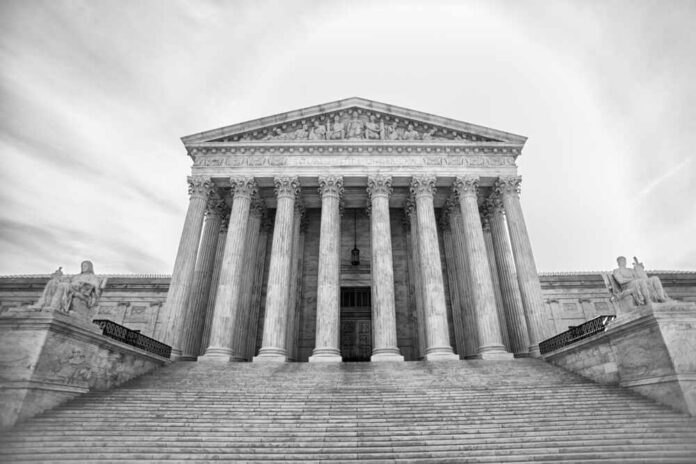
The Supreme Court just slammed the door on a last-minute Democratic push to erase New York’s only Republican House seat, rescuing GOP control in a city drowning in blue.
Story Snapshot
- SCOTUS blocks state judge’s order to redraw NY-11, preserving Staten Island’s GOP stronghold for 2026 midterms.
- Rep. Nicole Malliotakis secures her reelection path amid tight filing deadlines, averting electoral chaos.
- Challengers claimed vote dilution for Black and Latino voters (30% of district); defenders called redraw a racial gerrymander.
- Trump administration’s brief tips scales, reinforcing federal oversight over state meddling.
- Decision bolsters slim Republican House majority, signaling precedent for future redistricting battles.
Timeline of the Redistricting Clash
Fall 2025 voters, backed by Democratic interests, challenged NY-11 boundaries in New York Supreme Court. They alleged the map diluted Black and Latino votes, comprising roughly 30% of Staten Island’s population. Justice Jeffrey Pearlman ruled January 21, 2026, invalidating the lines and ordering the Independent Redistricting Commission to submit a new map by February 6. State appellate court denied a stay on February 19.
Supreme Court Steps In Decisively
Rep. Nicole Malliotakis and GOP defenders filed an emergency appeal to the U.S. Supreme Court in late February 2026. Democrats and Governor Kathy Hochul urged denial, citing time for state appeals. SCOTUS ruled the following Monday, granting a stay that blocked the redraw. This preserved the existing map through 2026 elections, just as congressional filings began.
Malliotakis argued Pearlman’s order violated Equal Protection by mandating racial gerrymandering. The Trump administration’s amicus brief labeled it an “open racial gerrymander.” Common sense aligns with this: forcing maps to boost specific groups risks unconstitutional balancing over fair representation.
Key Players and Their Stakes
NY-11 stands as New York’s lone GOP congressional seat amid Democratic NYC dominance. Malliotakis, the incumbent, leads defense efforts allied with GOP leadership and Trump forces. Challengers from Black and Latino communities sought stronger influence. Hochul and state officials prioritized sovereignty, referencing 2022’s swift redraw precedent. The Independent Redistricting Commission, meant for neutrality, faced a halted process.
Power tilted federally: SCOTUS overrode state courts pre-final appeal, leveraging national House control stakes. This clash pits state constitutional claims against federal protections, with GOP viewing redraws as partisan grabs.
Dem scheme to redraw NYC's lone GOP-held House seat blocked by SCOTUS https://t.co/73JdSF0WbO pic.twitter.com/xJ3TZCTyhH
— New York Post (@nypost) March 3, 2026
Immediate and Lasting Fallout
Short-term, Malliotakis stabilizes her campaign; GOP candidates avoid uncertainty. Democrats lose leverage in a district pivotal to House majority. Staten Island and Brooklyn residents maintain status quo, forgoing promised minority enhancements. Long-term, SCOTUS sets precedent for intervening on Equal Protection grounds, echoing Texas GOP and California fights.
Politically, Republicans gain nationally; Democrats cry court bias. Socially, minority claims persist without resolution. Broader redistricting wars loom post-2030 Census, with SCOTUS asserting dominance over state tinkering. Facts support GOP position: rushed racial tweaks undermine fair play and common sense governance.
Sources:
High Court Backs GOP District Lines in NYC Redistricting Fight
Democrats ask Supreme Court not to disrupt New York redistricting dispute