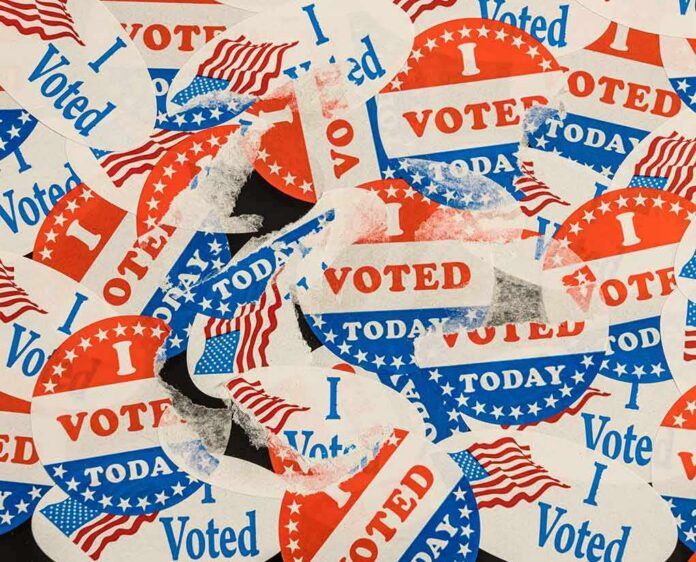
On Election Day in Minneapolis, voters turned “I Voted” stickers into tributes by covering two street memorials with dozens of them.
Story Snapshot
- Voters placed “I Voted” stickers on the Alex Pretti and Renee Good memorials on November 3, 2026.
- Local outlets observed dozens of stickers at both sites, with photos and video documenting the scene.
- At least one named voter linked her sticker to the memorial after casting a ballot.
- Reports did not identify a formal organizer or an exact count of stickers.
What Happened at the Minneapolis Memorials
On November 3, 2026, voters in Minneapolis left “I Voted” stickers at the memorials for Alex Pretti and Renee Good. Reporters on the ground described people placing the stickers on nearby poles, signs, and memorial displays. Local coverage said the stickers appeared throughout Election Day and that the activity took place at both sites in the city. Multiple outlets described the scale as “dozens,” reflecting more than a few isolated acts by passersby.
Photos and video published the same day supported the reports. A photo gallery showed close-up images of the memorial areas with visible sticker clusters. One caption identified a named participant standing at the Pretti memorial. Other reports referred to footage captured by local media showing stickers layered on the displays and nearby fixtures. The visual records gave onlookers a clear view of how the memorials looked as Election Day progressed in Minneapolis.
Who Took Part and Why It Mattered to Them
Minnesota Public Radio identified Minneapolis resident Peg Ihinger, who said she placed her early-voting sticker on a picture at the Pretti memorial. She said she was glad people were “really fired up to vote,” tying her action to civic energy and remembrance. Another report said a voter described feeling that the act linked their ballot to events earlier in the year, calling it the “right thing to do.” These statements provided insight into personal motives at the sites.
While several people spoke on record, coverage did not claim to capture every participant’s reasons. The reporting did not present a survey or full set of interviews. As a result, the stories show that some voters saw the act as a tribute that connected voting to loss and accountability, but they do not extend that motive to everyone involved. The limited quotes kept the focus on what could be documented in the moment, without broad claims.
How This Fits a Larger Civic Pattern
Across many elections, “I Voted” stickers have meant more than proof of a ballot. Researchers have found that these small badges can shape identity, encourage turnout, and spark public displays. One recent study reported that messages on stickers can affect how people feel about voting and whether they plan to vote at all. The Minneapolis scene fits that pattern by turning a private act into a visible, shared signal in a public space.
The sticker displays also highlight a tension that many Americans recognize. People across the political spectrum worry that government is not listening, and that institutions fail to protect basic fairness. Some see these stickers as a simple civic symbol. Others see them as speech about justice and the role of federal power. Both views can be true at once, which is why the display drew attention on a day built around public voice and accountability.
What We Know and What Remains Unclear
Reporters documented the time, place, and act: voters put dozens of stickers on the Good and Pretti memorials in Minneapolis on Election Day. The record includes named participants, on-site observations, and visual evidence. The coverage did not establish a final sticker count, identify a central organizer, or show approval from memorial custodians or families. Those limits do not change what happened; they set the bounds of what the reporting can say with confidence.
Sources:
youtube.com, news.com.au, newsweek.com, detroitnews.com, mprnews.org