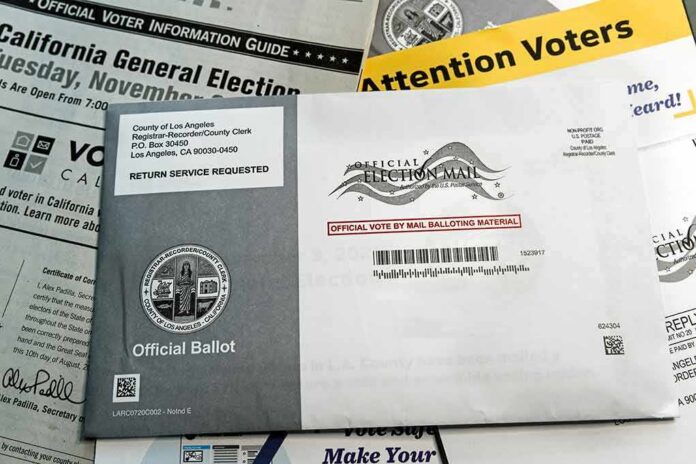
A little-noticed court order just gave President Trump’s team a powerful, if temporary, edge in the national fight over who controls mail-in voting.
Story Snapshot
- A federal appeals court in Washington briefly revived Trump’s plan to tighten mail-in ballot rules nationwide.
- The ruling lets the Postal Service keep working on a rule tied to Trump’s citizenship-verification order, despite earlier court blocks.
- Other judges have called Trump’s election orders unconstitutional, so the legal fight is far from over.
- The clash exposes a deeper struggle over whether federal agencies or states should control how Americans vote by mail.
D.C. Appeals Court Grants Trump A Procedural Win
On Friday, a three-judge panel of the United States Court of Appeals for the District of Columbia Circuit temporarily put on hold a lower court order that had blocked a new mail-in voting rule backed by President Trump. The panel said the lawsuit brought by the National Association for the Advancement of Colored People was “premature” because the United States Postal Service rule is still only proposed, not final. This stay lets the Postal Service continue its rulemaking process while the case moves forward, but it does not declare the rule legal.
The appeals court also signaled that Trump’s administration had met the strict test for a stay by showing it would be harmed if the Postal Service could not finish the rule before the midterm elections. Judges wrote that any possible harm to the challengers or the public did not outweigh the government’s showing on those key factors. At the same time, the panel clearly stated that its order “does not resolve the underlying case” or decide whether the rule ultimately follows the law, keeping the long-term outcome uncertain.
What Trump’s Mail-In Ballot Plan Would Do
Trump’s proposed rule grows out of his March executive order on “Ensuring Citizenship Verification and Integrity in Federal Elections,” which directs the Postal Service to limit federal mail-in ballots to voters listed on state-provided citizenship-verified rolls. Under the proposal, states would have to give the Postal Service detailed voter lists and unique barcodes for every federal mail ballot at least 30 days before mailing. Supporters say this would create an audit trail to keep ballots from going to non-citizens or people who should not be on the rolls. Critics warn it gives Washington new power over who gets a ballot at all.
Postmaster General David Steiner has told lawmakers that if a state refuses to share its voter data, the Postal Service would simply not deliver that state’s federal mail ballots. The Postal Service itself would not decide who belongs on the lists; that power would stay with the states. But the agency would become a gatekeeper, refusing to carry ballots unless states meet federal data demands. For many Americans who already worry the “deep state” does not respect local control, this looks like another example of distant officials steering elections from Washington.
Other Courts Push Back And Question Federal Power
Even as Trump won this round in Washington, he has lost important battles elsewhere. In June, a federal judge in Boston ruled that Trump’s directives to the Postal Service and the Department of Homeland Security go beyond the powers the Constitution gives a president over elections. That judge stressed that the Constitution assigns the job of setting federal election rules mainly to state legislatures and to Congress, not to the White House. Her order blocks key parts of Trump’s plan in the states that sued.
A separate judge in Washington, D.C., Emmet Sullivan, earlier found that the Postal Service’s proposed rule likely violates a 2021 settlement with the National Association for the Advancement of Colored People that requires special care and speedy handling of election mail through 2028. His injunction, now partially stayed by the appeals court, reflected fears that new hurdles so close to an election could delay or prevent ballot delivery for lawful voters. Voting-rights groups and Democratic-led states argue that Trump’s order is a “flagrantly unconstitutional” attempt to seize control of mail voting without approval from Congress.
Why This Fight Matters Beyond Partisan Politics
The dispute over Trump’s mail-in ballot rule is part of a longer struggle over who really runs American elections. For most of our history, the Postal Service has acted as a neutral carrier, simply delivering whatever election mail states send. Trump’s order would change that role and turn the Postal Service into an active gatekeeper, deciding which ballots move and which stay put based on federal rules and data demands. That shift alarms many on both the right and the left who already feel unelected bureaucrats are gaining too much control.
BREAKING ELECTION NEWS:
DC Circuit Gives Trump A Huge Election Integrity Victory On Mail-In Ballots…..
On Friday, the U.S. Court of Appeals for the District of Columbia Circuit issued a temporary order allowing the Postal Service to move forward with a proposed rule requiring… pic.twitter.com/dXrzDRHxGi
— Todd S. Regelski (@ToddRegelski) July 19, 2026
At the same time, many conservatives who watched messy mail voting in past elections see this proposed rule as long overdue. They point to reports of Postal Service facilities failing to follow election-mail procedures and warn that weak safeguards help fraud and errors slip through the cracks. Many liberals, however, worry the new rule could block legal voters, especially in states that cannot quickly build complex barcode systems or are wary of sharing sensitive voter information with Washington. Both sides, in different ways, see a government that looks more focused on power than on making voting both secure and fair.
Sources:
zerohedge.com, brookings.edu, time.com, nytimes.com, reuters.com, brennancenter.org, aclu.org, washingtonpost.com, whyy.org