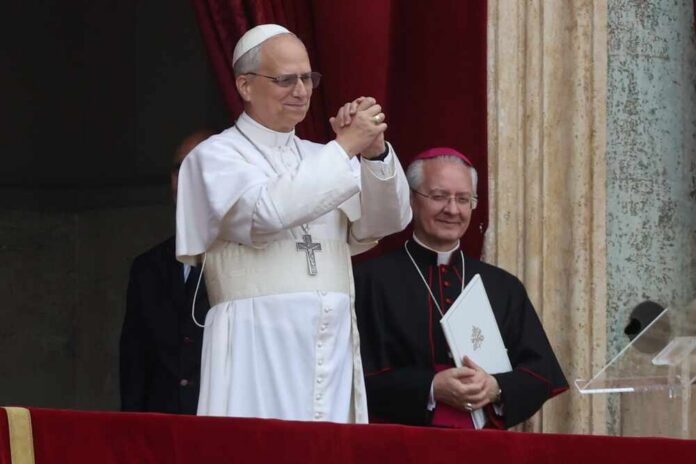
When a pope warns that artificial intelligence could drive “unending war” unless it is “disarmed,” and some Catholics whisper that only a Trump-led America can rein it in, it raises a sharper question: who, if anyone, is really in charge of this new power?
Story Snapshot
- Pope Leo XIV’s new encyclical and AI manifesto warn that artificial intelligence is amplifying inequality, misinformation, and the risk of war.[2]
- The Vatican argues that AI power is dangerously concentrated in the hands of a few corporations and governments, turning technology into a tool of domination rather than service.[3]
- Trump supporters and critics both frame him as a potential AI “tamer,” but the papal documents do not name him or tie their ethics agenda to any single U.S. leader.[1][2]
- Debate over “who controls AI” taps into shared left–right anger at global elites, big tech, and a federal government many see as captured by special interests.
Pope Leo’s AI Alarm: Truth, War, and Human Dignity
Pope Leo XIV’s first encyclical on artificial intelligence, Magnifica Humanitas, presents AI not as science fiction but as a fast-moving force reshaping work, politics, and even war.[3] The pope warns that AI systems are often portrayed as neutral while in reality they carry the biases and incentives of those who build and deploy them. He links this directly to threats to human dignity, warning that when algorithms decide who works, who is believed, or who is targeted, people become disposable.
In public addresses and in his AI “manifesto,” Leo argues that misinformation supercharged by AI can destabilize democracies and fuel conflict.[1] One broadcast summarizing his remarks notes his warning that technology-driven misinformation can “lead humanity down the path of unending war,” especially when citizens lose any shared sense of truth.[1] He also condemns the idea of turning over lethal battlefield decisions to autonomous systems, stating it is “not permissible” to entrust irreversible killing to machines.[2]
Concentrated Power: Big Tech, Governments, and “Armed” AI
The Vatican’s concern is not only what AI can do, but who controls it. In speeches on AI, Leo stresses that control of these systems “must not remain in the hands of a few,” warning that AI amplifies the economic and political power of existing elites.[3] His encyclical calls for AI to be “disarmed” from a logic of geopolitical and commercial dominance, criticizing an arms-race mindset where nations and corporations rush to outdo one another regardless of human cost.[2]
Vatican commentators and allied researchers highlight how current AI deployments often prioritize replacing workers, harvesting data, and manipulating attention over serving families and communities. Reports cited by Catholic media describe AI companies that seek “not to help workers, but to replace them,” echoing long-standing fears that regular people will absorb the shock while executives and investors profit. This critique resonates with both conservatives angry at globalist offshoring and liberals alarmed by growing inequality, even if they disagree on solutions.
Does the Pope “Need” Trump — or Something Bigger?
The claim that Pope Leo specifically “needs Trump to tame AI” reflects political commentary more than the text of his encyclical or Vatican briefings. Available coverage shows Leo calling for “robust regulation” of AI and urging developers, governments, and international institutions to put the human person and the common good first.[1] Neither the encyclical text nor mainstream reports document any appeal to Trump personally or any assertion that U.S. support from one administration is the linchpin for Vatican goals.[2][3]
‘Magnifica Humanitas’: Pope Leo Invokes Justice to Combat ‘Anti-Human Vision’ in AI
Published Monday, the Pope’s new encyclical warns of a ‘culture of power’ fueled by the digital revolution and artificial intelligence.https://t.co/8eeNd4p3uW— Catholicus Romanus ✝🙏🛡️⚔️ 🇺🇸🇧🇷🇦🇺🇳🇿🇮🇪 ☕ (@CatholicusRoma1) May 27, 2026
What the pope does say lines up with a deeper governance question that both Trump voters and his critics increasingly share: has high-tech power escaped democratic control? Leo’s insistence that AI is “neither objective nor neutral,” and that it must be governed by shared moral limits, challenges both Silicon Valley libertarianism and complacent bureaucrats worldwide. That challenge could appeal to an “America First” push to protect workers and sovereignty, and to progressive demands for corporate accountability—if leaders are willing to cross their own donors and entrenched interests.
Where Vatican AI Ethics Meets U.S. Political Frustration
Many Americans who feel abandoned by the federal government see AI as one more arena where distant elites make decisions and ordinary citizens bear the risks. Leo’s warnings that AI can widen inequality, destabilize jobs, and “fuel world conflict” speak directly to fears of a system rigged by powerful interests.[3] His call for technology that serves the human person rather than replacing or tracking them echoes anger over surveillance, outsourcing, and social media manipulation.
At the same time, the Vatican’s approach underscores how difficult it is to translate lofty ethics into binding rules. Leo urges policymakers to slow down reckless AI deployment, protect workers, and ban machine-made kill decisions.[2] But he also acknowledges the pace of AI change makes any statement quickly outdated and warns that regulation will require sustained international cooperation, not a one-time political gesture.[3] For Americans across the spectrum who see Washington as gridlocked and captured, that gap between moral clarity and practical action remains the central frustration.
Sources:
[1] Web – Pope Leo Needs Trump to Tame AI
[2] YouTube – Pope Leo urges leaders to slow down development of AI | ABC NEWS
[3] Web – Pope Leo calls to ‘disarm’ AI in major document, warns of …