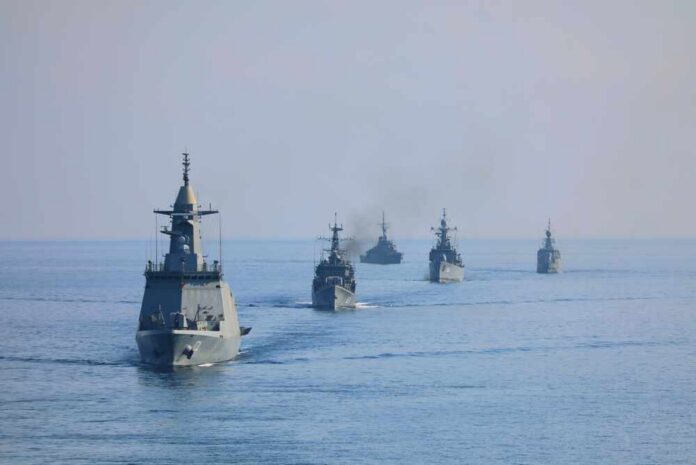
The Pentagon’s ambitious $1 trillion “Golden Fleet” plan to rebuild America’s Navy reveals a troubling reality: Washington is betting the nation’s security and economic future on a massive shipbuilding expansion while core questions about feasibility, cost, and industrial capacity remain unanswered.
At a Glance
- President Trump’s Navy plans to build 381 battle force ships by 2054 at a cost exceeding $1 trillion, requiring $40 billion annually in shipbuilding spending—a 57% increase over current budgets.
- The new Trump-class battleships will carry nuclear-armed sea-launched cruise missiles and advanced weapons systems, marking the first nuclear-armed surface combatants since 1991.
- U.S. shipyards face severe capacity constraints, prompting the Navy to outsource auxiliary vessel construction to Japan and South Korea, raising questions about American industrial self-sufficiency.
- Independent analysts warn the plan contradicts modern naval doctrine, integrates unproven technologies, and faces cancellation risk if administrations or budgets shift.
A Fleet Plan That Strains American Resources
The Navy’s 30-year shipbuilding strategy, announced in late 2025 and analyzed by the Congressional Budget Office in January 2026, targets 381 battle force ships by 2054. This expansion requires annual procurement spending to reach approximately $40 billion—a significant jump from today’s $255 billion baseline across all defense accounts. The total program cost exceeds $1 trillion, placing enormous pressure on federal budgets already strained by entitlement spending and debt service. Achieving this goal demands sustained political will across multiple administrations and congressional cycles, a commitment historically difficult to maintain when competing priorities emerge.
Nuclear Weapons Return to the Seas
The centerpiece of Trump’s “Golden Fleet” vision is the new Trump-class battleship, exemplified by the lead ship USS Defiant. These 35,000-ton vessels—triple the size of current Arleigh Burke-class destroyers—will carry nuclear-armed sea-launched cruise missiles (SLCM-N) and advanced hypersonic weapons. This represents the first deployment of nuclear weapons on U.S. surface combatants since 1991, when the Navy removed nuclear-armed Tomahawk missiles from surface ships. The return to nuclear-armed surface vessels escalates deterrence posture against China and Russia but raises arms control concerns and contradicts decades of nonproliferation policy favoring submarine-based deterrence.
Unproven Technology and Historical Lessons
The battleship design integrates weapons systems still in development or abandoned by the Navy. Railguns, initially heralded as revolutionary, were abandoned in 2021 after 15 years of development and billions in investment. High-powered lasers remain limited in operational range and effectiveness in adverse weather. Hypersonic cruise missiles are developmental. This pattern mirrors the Zumwalt-class destroyer program, which suffered massive cost overruns and technological disappointments. Critics at the Center for Strategic and International Studies argue these ships will cost approximately $9 billion each—making them extraordinarily expensive platforms vulnerable to saturation attacks from cheaper missiles and drones.
Outsourcing American Naval Power
Facing severe capacity constraints at domestic shipyards, the Navy plans to construct auxiliary vessels—oilers, supply ships, and support craft—overseas in Japan and South Korea. This decision reflects industrial reality: American yards are overwhelmed with combat ship construction and lack capacity for the full fleet expansion. Yet outsourcing auxiliary production raises strategic concerns about supply chain vulnerability, industrial base erosion, and dependence on allied nations during potential conflicts. Historically, the U.S. maintained robust domestic capacity across all naval ship classes; today’s reliance on foreign yards signals declining American industrial self-sufficiency in critical defense sectors.
Conflicting Naval Doctrine and Strategic Uncertainty
The battleship revival contradicts the Navy’s stated doctrine of distributed maritime operations, which emphasizes dispersed, smaller vessels over centralized firepower. Large battleships present concentrated, high-value targets vulnerable to hypersonic anti-ship missiles deployed by China and Russia. Navy leadership endorses the plan, but independent analysts question whether massive battleships align with 21st-century threats. If future administrations shift priorities or budgets tighten, the program faces cancellation before the first ship’s commissioning—a risk that makes long-term industrial planning and workforce development problematic.
Battleship to be nuclear-powered, Navy to build auxiliary ships overseas under new 30-year plan https://t.co/5JhuuE1rS2
— Inside Defense (@insidedefense) May 11, 2026
The “Golden Fleet” represents both American ambition and institutional strain. While rebuilding naval strength addresses legitimate strategic concerns about Chinese and Russian capabilities, the plan’s scale, unproven technologies, overseas outsourcing, and doctrinal tensions suggest Washington is overcommitting resources to a vision that may not survive political or budgetary reality. Working Americans—already frustrated with government spending and deficits—face a troubling prospect: massive public investment in weapons systems that experts question will ever fully materialize, while critical domestic priorities remain underfunded.
Sources:
CSIS Analysis: Golden Fleet’s Battleship Will Never Sail
Navy Times: Navy Shipbuilding Plan Would Cost $1 Trillion Over Next 30 Years
DefenseScoop: Trump Battleship Golden Fleet Navy Phelan
Navy Lookout: The Strategic Logic and Industrial Peril of Trump’s Battleship Plan for the U.S. Navy