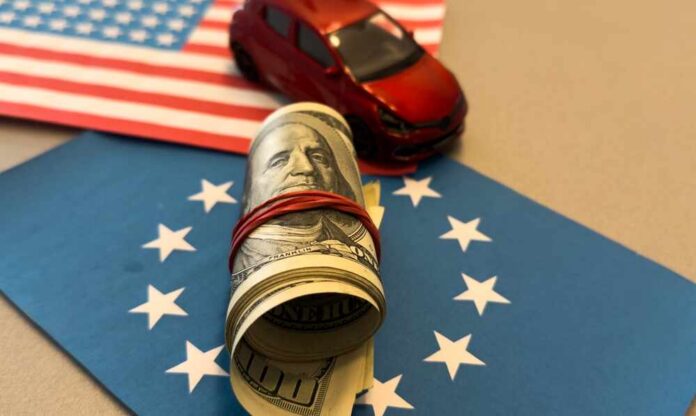
Trump’s new 25% tariff on imported cars is forcing a hard national debate: should Americans pay more at the dealership to claw back leverage from trading partners that keep U.S. exports boxed out?
Quick Take
- The Trump administration imposed a 25% tariff on imported passenger vehicles and key auto parts, using Section 232 national security authority.
- The White House argues the measure protects the U.S. industrial base and reduces dependence on foreign supply chains; the EU calls the tariffs a harmful tax on consumers.
- Analysts warn the policy could raise prices significantly on some models and trigger retaliation that hits U.S. exports.
- European producers—especially in Germany and Italy—face the biggest export and production impacts if the tariffs stick.
What the 25% auto tariff does and how it is being justified
President Donald Trump ordered a 25% tariff on imported passenger vehicles and major auto parts, including engines, transmissions, and electrical components. The administration invoked Section 232 of the Trade Expansion Act of 1962, a tool meant for situations where imports are deemed a national security risk. The White House framed the policy as a way to protect U.S. manufacturing capacity and reduce reliance on foreign producers for critical components.
Administration messaging also tied the move to long-running complaints about one-sided trade terms with Europe. The EU’s standard tariff on imported cars has been widely cited as higher than the U.S. rate, and Trump has repeatedly argued that these gaps, combined with other barriers, keep U.S.-made vehicles and farm products from competing fairly. The tariff announcement landed early in Trump’s second term, with collection beginning after the implementation window described by major outlets.
Europe’s response and why retaliation risk matters for U.S. workers
European Commission President Ursula von der Leyen publicly criticized the tariffs as taxes that hurt businesses and consumers, while signaling the EU would pursue negotiations and protect its interests. That “protect its interests” phrase is important: modern trade disputes rarely stay limited to one product category. When governments retaliate, they often target politically sensitive exports—meaning sectors outside autos can quickly get pulled into the fight even if they had nothing to do with the initial dispute.
Economic modeling of the tariff suggests Europe’s auto exporters would absorb major damage, particularly Germany and Italy, because they ship large volumes of higher-end vehicles to the U.S. market. In a scenario where U.S. tariffs stand, analysts project noticeable declines in European auto exports and associated production value. If the EU matched the U.S. move with similar auto tariffs, the models also anticipate a hit to U.S. auto exports, illustrating how “tough” trade actions can boomerang.
What U.S. consumers and supply chains are likely to feel first
Higher sticker prices are the most immediate pocketbook issue. Anderson Economic Group analysis referenced by mainstream reporting estimated price increases that can reach into the five figures for certain models, depending on how much of a vehicle or its parts supply chain is imported. Even buyers who prefer “buy American” can still get caught in the math, because many vehicles assembled in the United States rely on globally sourced components that may fall under parts tariffs.
Supply-chain complexity is also where the national security argument gets tested in real time. The U.S. auto industry supports large employment ecosystems—assembly plants, parts suppliers, logistics, dealerships—and a tariff can shift incentives toward domestic production over time. But abrupt cost increases can also disrupt production planning and inventory flow in the short term, particularly when manufacturers must certify parts, retool suppliers, or renegotiate contracts across North America and beyond.
The political significance: “America First” leverage vs. government trust gaps
Trade fights resonate in 2026 because they land at the intersection of wages, inflation, and public trust. Supporters see tariffs as one of the few tools Washington uses to defend domestic industry after decades of globalist policy choices that hollowed out manufacturing in many regions. Critics see tariffs as a tax that filters down to households. What both sides increasingly share is skepticism that institutions will manage the consequences competently or transparently once the headlines fade.
Trump Slaps 25% Tariff on European Union Cars, Says Bloc Not Complying with Trade Deal
READ: https://t.co/kANIalf8hw pic.twitter.com/BwCjm9A0T9
— The Gateway Pundit (@gatewaypundit) May 1, 2026
Revenue projections vary widely across public claims, and the EU non-compliance framing has been disputed in the sense that specific breached deal terms are not clearly established in the public documentation cited. That uncertainty does not prove the tariff is wrong—but it does underline why citizens demand clearer metrics: what counts as success, how price impacts will be tracked, and what off-ramps exist if retaliation escalates.
Sources:
Driving into uncertainty: How Trump’s tariffs could derail Europe’s automotive powerhouse
Trump auto tariffs: GM, Ford, Stellantis and what it could mean for car prices