Seven shots fired into a car during a federal arrest — with a 5-year-old inside — have turned a New York street into a national test of force, accountability, and trust.
Story Highlights
- Homeland Security says agents targeted a man with a serious criminal record during an arrest operation.
- New York officials say cameras show the car moved as agents approached; at least seven rounds were fired.
- The 28-year-old, identified as Oscar Belgal, was wounded; his child was unharmed, sparking protests.
- Leaders demand body-camera video and a full account; key footage has not been released publicly.
What Officials Say Happened During the Arrest
The Department of Homeland Security said Immigration and Customs Enforcement officers carried out a targeted arrest in Manhattan’s Marble Hill. Officials said the team moved on a suspect described as a Dominican national with a grand larceny conviction and multiple prior arrests for assault, robbery, drugs, and weapons. Officers tried to box in the car to make the arrest. The agency framed the operation as focused on a named suspect with public safety concerns.
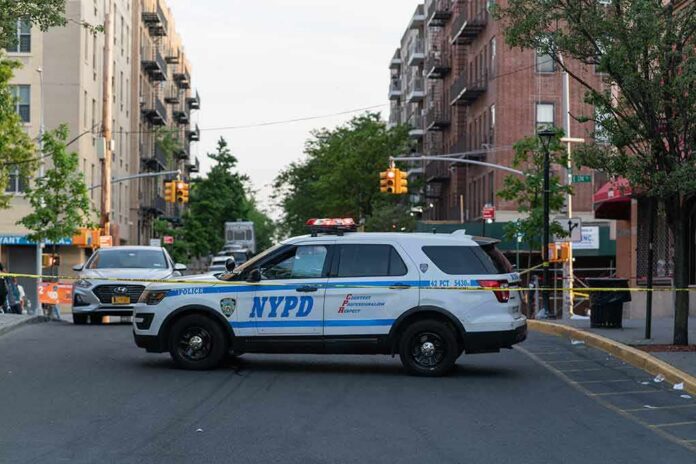
New York Police Department Commissioner Jessica Tisch said city cameras captured the approach and showed the vehicle move forward as agents came to the driver’s window. At least one agent then fired seven shots. Investigators recovered seven shell casings and documented bullet damage on the vehicle. Officials reported that agents rendered aid. The injured man was transported in stable condition, and a child in the car was later found safe with family.
The Man at the Center and Unanswered Questions
News outlets identified the man as 28-year-old Oscar Belgal, based on law enforcement sources and prior records. Federal statements also linked him to the Trinitarios gang. These details, if confirmed, support why officers viewed him as a higher-risk target. But the record offered to the public so far is thin on the exact moment-by-moment threat call. There is no body-camera video released, no sworn agent statement, and no use-of-force report available yet.
Officials said the vehicle moved as agents approached, and one outlet reported a federal claim that the car rammed government vehicles. That ramming claim does not appear across other briefings in the available record. Without body-camera footage, the case rests on statements and summaries. That gap feeds doubt across the spectrum and leaves proportionality questions, especially with a child in the back seat, unresolved in public view.
New York Leaders Condemn the Shooting and Demand Video
Mayor Zohran Mamdani called the shooting “an outrage” and questioned how agents fired so many rounds into a car with a 5-year-old inside. He said Immigration and Customs Enforcement acts with impunity and should be abolished. Governor Kathy Hochul urged a full and transparent account and pushed for immediate release of body-camera footage. Both leaders demanded a halt to federal enforcement operations in the city after the incident.
Protesters gathered outside the hospital and in nearby streets. Some witnesses described a chaotic scene and shared emotional accounts, including reports of the child screaming. The public reaction reflects a deep trust gap over federal force in local neighborhoods. Many residents see these crackdowns as bringing danger to bystanders, not safety. Police reported crowd control challenges as anger built through the evening.
Wider Pattern: Cars, Force, and Delayed Transparency
This event fits a larger pattern seen in recent years. Immigration arrests near vehicles often escalate fast. Agents cite cars as potential weapons. Critics focus on whether tactics caused the danger. Investigations have documented dozens of shootings by immigration officers in the past decade, with many tied to vehicle encounters. National reporting shows that official accounts after violent encounters have sometimes faced later contradictions when evidence surfaced.
Unrest erupts in the Bronx after an ICE officer shoots and injures a man during a targeted immigration operation, with demonstrators clashing with law enforcement and multiple people taken into custody.
Images show chaotic scenes as agitators block federal vehicles, smash car… pic.twitter.com/zmRnaMCRLZ
— Terrie (@Terrie229985) October 9, 2026
Policy also looms large. The law permits deadly force only when a person poses a serious danger. Agencies say they train to use the minimum force needed. Yet public confidence depends on timely video, clear reasoning, and proof that plans accounted for known risks, like a child in a car. Until footage and reports are released, both supporters and critics will project their fears onto the facts we cannot yet see.
What To Watch Next
Key next steps include release of body-camera and surveillance video, the federal use-of-force report, and any after-action review. A precise timeline, ballistic mapping, and statements from involved agents could confirm whether the car created an imminent threat. Clear answers on what officers knew about the child, and what options they weighed, will shape public judgment. Without those records, the debate hardens, and trust in government on both sides continues to erode.
Sources:
youtube.com, cnn.com, nbcnews.com, abc7ny.com, us.headtopics.com, newsbreak.com, cbsnews.com, time.com, bronx.news12.com, nbcnewyork.com, edition.cnn.com, nytimes.com