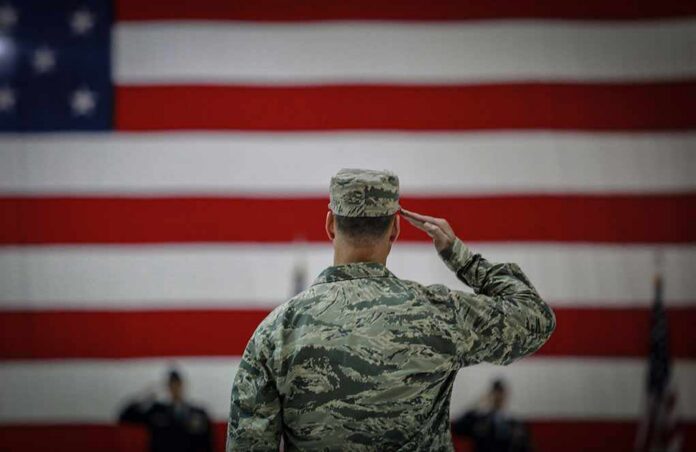
President Trump approved execution by U.S. Army firing squad for convicted Fort Hood shooter Nidal Hasan, marking the first U.S. military execution move in more than six decades.
Story Highlights
- The Pentagon says President Trump approved a firing squad for Nidal Hasan’s execution.
- Hasan was convicted for killing 13 people in the 2009 Fort Hood attack.
- The case would be the first U.S. military execution in over 60 years if carried out.
- The decision lands amid broader debates over execution methods nationwide.
Pentagon Says Trump Approved Firing Squad for Hasan
Pentagon spokesperson Sean Parnell said Secretary of Defense Pete Hegseth recommended, and President Trump approved, death by U.S. Army firing squad for Nidal Malik Hasan. Reports describe this as the first U.S. military execution action in more than 60 years if it proceeds. Coverage ties the approval directly to Trump and Hegseth by name and quotes the Pentagon attribution on the method. The reporting does not include the full underlying order text, but it is consistent across several outlets.
Hasan, a former Army major, was convicted for the 2009 shooting at Fort Hood, Texas, that killed 13 people and wounded dozens more. Military courts sentenced him to death after his court-martial. The new development concerns how the sentence would be carried out, not whether he was guilty. The Pentagon statement, as reported, assigns the choice of method to the Department of Defense leadership and the President’s sign-off, reflecting the military chain of command on capital cases.
Why This Decision Is Historically Significant
United States military executions are rare, and none have occurred in decades. Reports note that this would be the first such military execution in more than 60 years if it happens. In the civilian system, firing squads are also unusual. Since 1976, the firing squad accounts for a fraction of U.S. executions, making up well under one percent, according to analysis cited by death penalty researchers. That rarity makes the Pentagon’s stated plan stand out in both legal and cultural terms.
The method also has a charged history in American life. During earlier wars, firing squads appeared mainly in military justice, not civilian courts. Modern debate often centers on whether a method is reliable, swift, and less likely to be botched than alternatives. Advocates argue a firing squad can produce a quick death when carried out by trained shooters. Critics focus on the image of state violence and the moral weight of the act, regardless of method.
What Else Is Driving Method-of-Execution Debates
States have struggled to carry out lethal injections due to drug shortages and legal fights. That has pushed some to consider or authorize other methods. Several states allow firing squads in limited cases, reflecting a search for legally durable options when injections are not workable. These policy shifts show how the execution method often becomes the focus even when the sentence itself is final. The Pentagon’s move fits inside that wider national pattern.
Idaho recently updated its execution framework and built out an execution chamber, drawing attention to non-injection methods in the civilian system. Analysts have tracked how rare methods return when the standard one stalls. Military justice is distinct, but it faces the same practical test: can the government carry out a lawful sentence in a way that meets policy, legal, and operational standards? That question explains why method choices attract national scrutiny.
What Comes Next Procedurally
The reported approval sets the method but does not lay out a public timeline. The media accounts do not include a detailed Pentagon order, location plans, or protocol steps for a firing squad in a military setting. Military justice normally requires coordination among defense leadership, legal offices, corrections officials, and the chain of command. Any scheduled date would likely follow internal reviews and logistics planning. Outlet reports did not describe those next steps in detail.
Why It Resonates Across the Political Spectrum
Families of the fallen at Fort Hood have waited many years for closure. Some readers will see this move as long-delayed accountability for a brutal attack on Americans in uniform. Others will focus on the government’s power to take a life and the method’s symbolism. Both reactions reflect a deeper worry: institutions often move slowly, reveal little, and seem distant from public concerns. This decision brings those tensions into sharp view, in a case few have forgotten.
Sources:
idahostatesman.com, idahonews.com, nypost.com, legislature.idaho.gov, idoc.idaho.gov