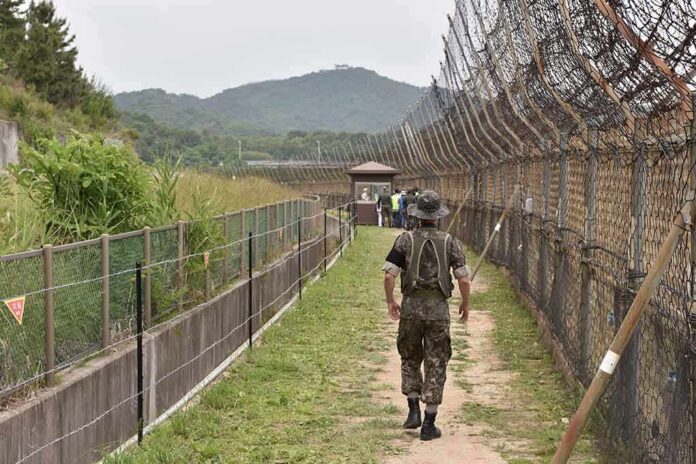
An explosion inside the Korean Demilitarized Zone injured three South Korean service members during a routine operation, underscoring the quiet, constant danger of one of the world’s most mined borders.
Story Snapshot
- Three South Korean personnel were injured in the western Demilitarized Zone during a planned operation.
- Officials said the blast happened south of the Military Demarcation Line; two were airlifted for treatment.
- Authorities called it an “unidentified explosion,” with a landmine viewed as the likely cause.
- The area is long known for heavy mine contamination and recurring accident risks.
What Happened Inside the Demilitarized Zone
South Korea’s military reported that three personnel were hurt Monday during an operation in the western sector of the Demilitarized Zone, at a point south of the Military Demarcation Line. Officials described the event as an “unidentified explosion.” Early details indicate two were evacuated by helicopter and a third was moved for medical exams. The Joint Chiefs of Staff said the team was working in the area when the blast occurred during a scheduled task, not a firefight.
Wire reports used different terms for those injured, calling them “soldiers” or “officers.” The military has not publicly clarified their ranks. Reuters cited President Lee Jae Myung saying the team had been clearing a patrol route when the blast occurred, and that a landmine caused the explosion. Other outlets quoted the military as saying the cause was still under review, though a landmine was considered likely based on initial signs at the site.
How the Blast Fits a Known Hazard
Accidents in the Demilitarized Zone often trace back to mines or old unexploded ordnance. The border region has a long record of such incidents affecting patrols and work crews. Scholars and legal references describe the Demilitarized Zone and nearby areas as infused with extensive minefields laid over decades. Estimates place the number of mines across the border zones in the hundreds of thousands or more, which helps explain why routine missions sometimes face sudden blasts without warning.
The early information pattern also fits past cases at the border. After an explosion, military officials release short statements. News services converge on a likely cause based on past events and field conditions. Then an investigation works to confirm the exact device and trigger. That process can take time, and some findings may never be made public due to security limits in the Demilitarized Zone and operational concerns, which restrict outside inspection and detailed releases.
Why This Matters Beyond the Battlefield
Border safety is not only a military issue; it is a governance test. When a dangerous frontier remains sown with old weapons, accidents will continue to hurt people doing their jobs. Many readers on the right and the left see this as part of a larger failure: leaders often talk tough yet leave long-running risks in place. That disconnect feeds the belief that institutions protect themselves first and fix root problems later, if ever.
For Americans watching from afar, the lesson is familiar. Complex systems drift until a crisis forces action. Voters across the spectrum want responsive, accountable government that solves hard problems, not just manages headlines. The Demilitarized Zone shows how decades of delay harden into daily hazards. Mine clearance, clear communication, and transparent reviews are the basic steps citizens expect, whether on a foreign border or at home.
What Officials Can Do Next
South Korean authorities can release a concise incident report once the on-site review ends. Key facts include the exact location south of the Military Demarcation Line, the mission type, the device identification, and the injury assessment. Those details can confirm whether a landmine caused the blast and guide safer patrol routes. Even a brief public summary builds trust while keeping sensitive tactics protected, which is vital in a tense border zone.
Monday, 9/21/2026 Three South Korean military officers from the Army’s 25th Infantry Division were injured by an explosion in the western sector of the Demilitarized Zone (DMZ), south of the Military Demarcation Line (MDL) according to Multiple credible South Korean news sources.
— #BTC (@FX191976) September 21, 2026
Longer term, steady mine-clearing in approved areas, improved mapping, and better route controls reduce risk. Prior demining projects have shown progress when teams work to verify fields and remove ordnance. Each cleared lane lowers the chance that a routine patrol ends in tragedy. That is slow, technical work. But it is also the kind of work that proves governments can keep service members safe while managing a hard security mission on a volatile frontier.
Sources:
military.com, ajc.com, abcnews.com, en.sedaily.com