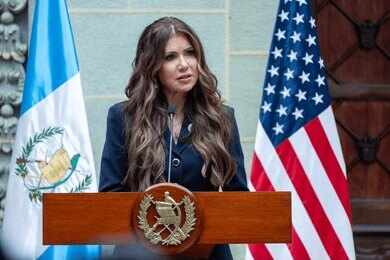
One Senate exchange just put Democrats’ election “intimidation” narrative on a collision course with the basic question they refuse to answer: how serious are they about stopping illegal voting?
Quick Take
- DHS Secretary Kristi Noem told Sen. Chris Coons there were “no plans” to deploy ICE or CBP to polling places, but she would not rule it out outright.
- Coons pressed Noem on voter “intimidation” fears ahead of the 2026 midterms; Noem fired back by asking whether Democrats plan to allow illegal aliens to vote.
- Prior DHS-related assurances suggested agents would not be sent to voting locations, creating a visible gap between earlier messaging and Noem’s careful wording.
- Federal law generally restricts federal law enforcement or military presence at polling places except under narrow circumstances, making the issue legally sensitive.
Judiciary hearing spotlights a 2026 midterm flashpoint
Sen. Chris Coons, a Delaware Democrat, used a Senate Judiciary Committee hearing to question DHS Secretary Kristi Noem about whether immigration agents could show up at polling places ahead of the 2026 midterm elections. Coons framed the concern as protecting voters from intimidation. Noem replied that there were “no plans” for ICE or CBP deployments at polling sites, but she did not provide the categorical “never” commitment Coons sought.
The moment that drew the most attention came when Noem turned the question back on Coons: “Do you plan on illegal aliens voting in our elections, Senator?” Coons denied any such plan, and Noem responded that there should be no need for the scenario he described if illegal voting is not being contemplated. Coons called the exchange “concerning,” arguing that the refusal to rule out deployments still raises constitutional red flags for voters.
What the law says, and why both sides are talking past each other
The legal tension is real. Federal law generally bars federal law enforcement or military presence at polls except under specific court-ordered circumstances, which is why the idea of agents stationed at voting locations triggers immediate scrutiny. Democrats are leaning on that principle to argue the mere possibility chills turnout. Republicans, meanwhile, focus on the equally basic principle that elections must be limited to eligible voters—citizens under state rules.
Coons’ line of questioning also landed in a climate shaped by aggressive immigration enforcement under President Trump, a sharp break from the Biden-era posture many conservatives viewed as permissive. The hearing covered more than polling places, touching on ICE enforcement priorities, training standards, and whether the department is operating under arrest “quotas.” It indicates Noem denied quotas even as other administration figures have publicly pushed for major increases in daily arrests.
Conflicting signals inside DHS keep the controversy alive
The controversy is amplified by a messaging split: Acting ICE Director Todd Lyons previously testified there would be “no reason” to deploy agents to polling sites, and senior DHS officials reportedly assured state election officials that armed federal agents would not be sent to voting locations. Noem’s “no plans” answer fits those assurances in spirit, but her refusal to rule out future deployments leaves Democrats room to claim the door remains open.
That gap matters politically because it lets each side argue it is defending the Constitution. Democrats emphasize the right to vote free of coercion, especially for communities sensitive to law enforcement presence. Conservatives emphasize the integrity of the ballot box and argue that election administration cannot ignore public concern about non-citizen voting, even if specific cases are disputed state by state. The hearing did not resolve that clash; it broadcast it.
What to watch next as 2026 election rules collide with enforcement politics
No formal DHS commitment emerged from the hearing beyond Noem’s statement that there were “no plans” for agents at polling places. That keeps the matter in a gray zone: the administration can point to the lack of any announced deployment, while critics can argue the refusal to foreclose it invites fear and litigation. This could escalate into legal challenges if any policy or operational guidance appears to test federal restrictions.
Kristi Noem Made Dem Sen. Chris Coons' Line of ICE Questioning Backfire With a Brutal Retort https://t.co/csw8qHMRY9
— Gloria Murphy (@GloriaMurp59364) March 4, 2026
For voters tired of years of institutional double standards—softness on illegal immigration paired with lectures about “democracy”—the exchange shows why confidence is hard to rebuild. If DHS sticks to existing legal guardrails, the polling-place issue may fade. If political actors keep floating the concept as a deterrent, it will remain a ready-made midterm weapon. Either way, the hearing clarified one reality: election integrity and federal power will be inseparable themes in 2026.
Sources:
Coons Questions ICE at Polling Places as Noem Fires Back ‘Illegals Voting?’
ICE won’t be at polling places