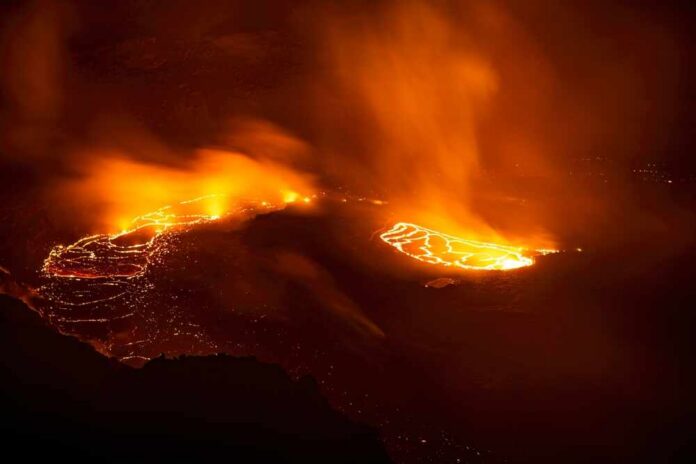
Hawaii’s Kīlauea Volcano unleashes its 46th explosive eruption of 2026, raising urgent questions about federal oversight of natural disasters in an era of government mistrust.
Story Highlights
- Kīlauea summit enters Episode 46 on May 5, 2026, with lava fountains blasting from Halemaʻumaʻu crater vents since 8:17 a.m. HST.
- USGS Hawaiian Volcano Observatory escalated alert to WATCH/ORANGE on May 4 amid precursory flows and inflation signals.
- Tephra, ash, and Pele’s hair fallout threaten southwest communities and park visitors under light trade winds.
- This ongoing sequence since December 2024 nears the historical record of 47 episodes from 1983-1986, with no rift zone threats.
Eruption Timeline and Precursors
Kīlauea volcano on Hawaiʻi Island’s southeast flank began Episode 46 fountaining at 8:17 a.m. HST on May 5, 2026. Precursory lava flows started from the north vent around 1:38 a.m. on May 4. USGS Hawaiian Volcano Observatory detected 13.2 microradians of inflation after post-Episode 45 deflation. The agency forecasted this event within a May 4-7 window based on tiltmeter and GPS data. No East Rift Zone or Southwest Rift Zone activity occurred. Episodes typically last under 12 hours, separated by over three-week pauses. This pattern underscores the volcano’s predictable yet relentless basaltic activity driven by the Hawaiian hotspot mantle plume. Reliable monitoring by USGS prevents surprises, yet exposes gaps in broader federal disaster coordination that frustrate citizens on both sides of the aisle.
Stakeholder Responses and Safety Measures
USGS HVO leads monitoring and issued the WATCH/ORANGE alert on May 4 to signal elevated unrest. Hawaiʻi Volcanoes National Park coordinates access restrictions for viewer safety, balancing tourism with hazard mitigation. Hawaiʻi County Civil Defense urged residents in southwest areas to prepare for tephra and Pele’s hair by disconnecting catchment systems. No road closures occurred as of May 6, but aviation faces ORANGE-level risks from ash clouds. Local communities downwind rely on these hierarchical alerts. Federal agencies like USGS demonstrate competence here, contrasting with perceptions of deep state inefficiencies elsewhere. Effective collaboration bolsters resilience, aligning with conservative values of limited but accountable government intervention.
Impacts on Communities and Economy
Tephra fallout heaviest within three miles affects park facilities and southwest communities, requiring cleanup without major evacuations. Episode 45 produced 6.8 million cubic yards of lava from a 900-foot fountain over 8.5 hours, reshaping Halemaʻumaʻu crater floor. Big Island tourism, worth $5 billion annually with volcanoes drawing 20%, faces temporary dips from caution advisories. No widespread economic disruption emerged, but cultural reverence for Pele adds social weight. Long-term, this 17-month sequence could tie the 47-episode record, enriching geologic data. Such events highlight how natural forces demand practical federal-local partnerships over bureaucratic overreach, a concern shared across political lines amid elite detachment from everyday American struggles.
Expert Analysis and Historical Context
USGS experts note inflation as the key predictor for these short episodes. Geophysicist Stefan Burns connects activity to the Hawaiian hotspot, observing a solar storm coincidence without causal links. Historical precedents include 47 summit episodes in the early 1983-1986 Puʻu ʻŌʻō phase and shorter 2020-2021 sequences. Media like Fox Weather emphasize the spectacle alongside risks, prioritizing safety. This alignment avoids alarmism, focusing on verified patterns. In a time when both conservatives and liberals decry government failures, Kīlauea’s precise tracking exemplifies science-driven governance that respects individual initiative and traditional self-reliance principles.
Hawaii’s Kilauea Volcano blasts out fountains of lava in 46th eruption of 2026 Cameras set up by the USGS around Hawaiʻi Volcanoes National Park show the growing strength as lava continues to gush from the summit. https://t.co/fTGiJrf8w2 pic.twitter.com/oAkFCpBBHQ
— UnfilteredAmerica (@NahBabyNahNah) May 6, 2026
Sources:
Kilauea Volcano Lava Eruption Window Opens
Fox Weather: Mount Kilauea Volcano Spews Lava in 46th Eruption
USGS Volcanoes: Kīlauea Status
Kilauea Volcano Alert Level Raised to WATCH