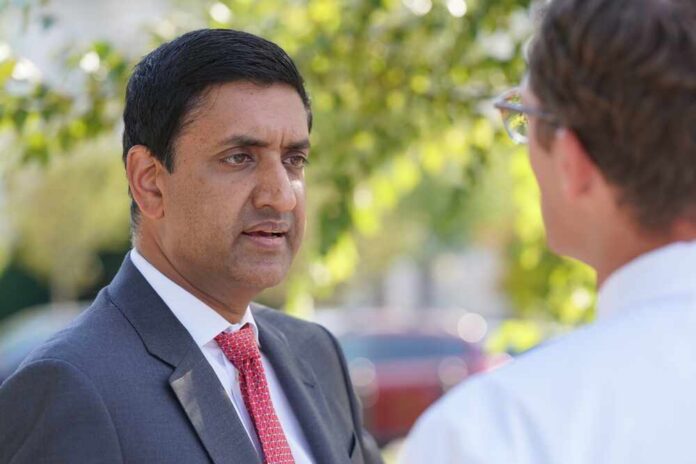
A progressive congressman who campaigns against concentrated wealth is facing scrutiny over his personal finances, although many of the most dramatic claims remain unverified.
Story Snapshot
- Claims say Rep. Ro Khanna lives in a mansion with a four-story elevator and owns three private golf courses, but no primary records confirm this.
- Khanna does appear to be wealthy and has stock and other assets, yet official disclosures do not show anything close to a $340 million net worth.
- At the same time, Khanna backs wealth taxes and laws to curb corporate home buying, creating a clash between his message and his money.
- This fight feeds a wider anger on both left and right that elites in Washington preach one thing and live another.
What We Actually Know About Khanna’s Money
Rep. Ro Khanna from California is a well-known progressive voice who represents part of Silicon Valley. Public financial disclosure forms, which members of Congress must file by law, list his and his family’s assets and trades across many stocks and funds. One local report found that Khanna or his family made multiple trades in Palantir, a tech company with big federal contracts, mostly in the $1,000 to $15,000 range, with one larger buy up to $50,000. Business Insider also reported that his children each held between $50,000 and $100,000 in major company stocks like Pfizer and Meta, while his wife bought up to $15,000 in a Russian tech firm. These figures show that Khanna’s family is clearly affluent, but they look more like upper-class congressional wealth than like a billionaire-style fortune.
The viral $340 million net worth figure comes from a single Yahoo-style commentary piece that calls his lifestyle “staggering” but does not link to tax records or full disclosure forms. Independent sites that track congressional finances, like LegiStorm and OpenSecrets, list Khanna as wealthy but do not support anything near hundreds of millions of dollars. The House of Representatives’ official disclosure system holds his detailed forms, and anyone can request them or access recent years online. That means hard data exists, but the online claims rushing across social media cherry-pick the most shocking number without tying it back to those official filings. For citizens tired of spin from both parties, this gap between viral outrage and verifiable records should raise a red flag.
The Luxury Mansion and Golf Course Allegations
The latest storm came from conservative posts and The Gateway Pundit, which say Khanna lives in a mansion with a four-story elevator and that his children own three private golf courses. A former hedge fund manager, Martin Shkreli, added fuel by tweeting that Khanna’s family bought “one of the most expensive houses in Virginia.” These details are explosive because they fit a picture of an elite politician living in extreme luxury while speaking against oligarchy. But in the public record there are no property deeds, building permits, or business registrations that confirm an elevator spanning four floors or personal ownership of multiple golf courses tied to Khanna’s name. The golf course story, in particular, appears only in viral posts and has not been backed up by land records or company filings.
That does not mean Khanna lives modestly. Reports describe him spending time in a large Washington, D.C. home when away from his district, and his disclosure forms show sizable assets and investments that many ordinary Americans could never dream of holding. For conservatives fed up with “woke” politicians and for liberals angry about growing inequality, a rich member of Congress talking populist still feels like part of a broken system. But the most dramatic charges in this case rest on repeating social media claims rather than on bank statements, county records, or confirmed blueprints. In an era when many believe the “deep state” and the donor class hide the real story, it is important to separate proven excess from online rumor.
Khanna’s Anti‑Oligarchy Record and the Hypocrisy Debate
Khanna has built his brand around fighting concentrated wealth and power. He has publicly backed a five percent wealth tax on billionaires, arguing that people at the very top should pay more to support working families and rebuild the middle class. He introduced the “Stop Wall Street Landlords Act,” a bill aimed at stopping private equity firms and large corporations from buying up single-family homes and turning entire neighborhoods into rental markets controlled by distant investors. In another housing push, he authored provisions to limit institutional investors to owning no more than 350 single-family homes and to convert empty office buildings into housing. These moves place him clearly in the anti‑oligarchy camp on policy.
The clash comes from the gap between that rhetoric and his own comfort. Many Americans on both sides already feel Washington is run by a wealthy club that writes rules for everyone else. When a lawmaker attacks Wall Street, then shows up in headlines over stock trades in a controversial federal contractor or rumors of palatial homes, it confirms the sense that elites talk about fairness while staying rich themselves. Research on wealthy Americans shows they are usually very active in politics and often prefer cutting social spending over deeper tax hikes, feeding fears that economic power always bends policy back toward the few. Khanna’s voting record is not that of a budget‑cutting conservative, but his personal wealth still keeps him inside the same upper class that many voters distrust.
Why This Story Matters Beyond Khanna
This fight over Ro Khanna’s lifestyle fits a long pattern. Progressive leaders like Bernie Sanders and Elizabeth Warren have been hit with similar attacks for owning nice homes or drawing big salaries while calling for more economic fairness. Conservative media often spot a story of “liberal hypocrisy” and drive it hard, sometimes with thin verification, because it resonates with people who already believe elites lie. At the same time, academic work shows that many voters, including some conservatives, support policies that reduce extreme inequality when framed in moral terms like fairness and responsibility. In other words, the anger is real, but the facts in any single case can be messy.
For citizens who feel shut out of the American Dream, this story is less about one elevator or a golf course and more about trust. They see wealthy politicians in both parties, from Trump‑aligned Republicans to Silicon Valley Democrats, trading stocks, raising huge campaign checks, and living far above the median household while promising to fix inflation, housing costs, and broken schools. Whether or not Khanna owns the specific luxuries claimed, he is part of a ruling class that appears insulated from the pain of ordinary life. That reality fuels calls from both left and right to tighten ethics rules, ban or severely limit stock trading by members of Congress, and demand full transparency on assets, taxes, and outside business ties. If America wants to “fight the oligarchy,” it will need proof and sunlight, not just viral outrage.
Sources:
thegatewaypundit.com, yahoo.com, x.com, reddit.com, heritageaction.com, youtube.com, facebook.com, khanna.house.gov, instagram.com, disclosures-clerk.house.gov, scribd.com, oge.gov, fsu-flvc.primo.exlibrisgroup.com, pmc.ncbi.nlm.nih.gov, cambridge.org