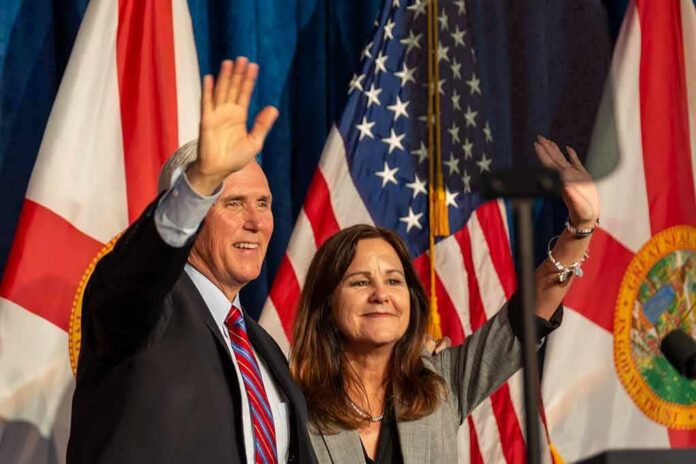
Mike Pence reopened the 2028 question and warned Republicans that principles, not personalities, will decide their future.
Story Highlights
- Pence left the door open to a 2028 presidential run in a new interview.
- He urged Republicans to return to strong defense, limited government, fiscal discipline, and the right to life.
- He tied his message to Republican setbacks in the 2026 midterms.
- He gave no timeline, announced no committee, and named no supporters.
Pence Signals Openness To 2028 Run After Midterm Setbacks
Former Vice President Mike Pence declined to rule out a 2028 presidential bid in a Fox News Digital interview published November 12, 2026. He said people across the country have urged him to consider running and added that he was humbled by the outreach. He did not set a decision date or describe any formal steps toward a campaign. The interview was his first since the 2026 midterm elections, which he referenced directly in his remarks.
Pence’s openness marks a shift from comments two months earlier, when he said he had no plans to seek the presidency or any other office in 2028. The new remarks came as Republicans assessed losses in key races. Pence linked the results to what he called a broader problem inside the party. He stopped short of blaming specific figures but framed the election as a warning about the party’s current direction.
Call For A Return To Four Conservative Pillars
Pence argued that the Republican Party must recommit to four pillars: a strong national defense, limited government, fiscal responsibility, and the right to life. He said these principles matter more than any single nominee and warned that 2028 will not break the party’s slump without them. His message echoes a familiar debate on the right about whether Republican identity rests on long-held ideas or on recent populist themes and tactics.
Supporters can view this platform as a clear contrast with recent party trends. Critics may see it as a throwback that does not address current voter concerns on costs, health care, and border security. Pence did not outline specific laws, budget targets, or defense priorities to carry out his approach. He also did not explain how his plan would change midterm outcomes or appeal to swing voters in tight states and districts.
No Announcement, No Infrastructure, And Next Steps
The interview contained no formal launch, no exploratory committee, and no staffing or fundraising details. Pence did not identify any of the people urging him to run. That leaves the scale of interest unclear and keeps the story in the realm of public testing, not a campaign. Such signals are common in early cycles, allowing a figure to gauge demand before accepting the costs and scrutiny of a declared bid.
It looks like Mike Pence will run in 2028. I agree that he is an articulate spokesman for (domestic) limited government and that he took a principled stand on Jan 6.
But he is reflexively pro-War and so I am very sorry to see @CatoInstitute elevate him.https://t.co/hNXKPVLGfa
— Marc Joffe (@marcjoffe) November 13, 2026
If Pence advances, the next markers would be concrete and public: a Federal Election Commission filing, a named team, a finance plan, and travel to early primary states. If he holds back, the interview still places his policy case into the 2028 conversation. For voters on the right and left who feel national leaders protect their own power, this moment underscores how party brands can drift while everyday families face rising costs, safety worries, and little accountability in Washington.