Shots near the White House Correspondents’ Dinner exposed how quickly a high-profile “elite” event can turn into a security emergency—even with the president in the room.
Quick Take
- Gunfire erupted near the WHCA dinner at the Washington Hilton on April 25, 2026, prompting an immediate Secret Service evacuation of President Trump and First Lady Melania Trump.
- Reports described multiple shots and a rapid law-enforcement response that ended with a suspect detained after attempting to breach a security checkpoint.
- President Trump praised law enforcement on Truth Social and signaled a desire to continue the event if authorities allowed.
- Asked whether he was the intended target, Trump replied, “I guess,” highlighting how little confirmed information was available in the immediate aftermath.
What happened at the Washington Hilton
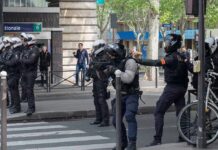
Gunfire disrupted the White House Correspondents’ Association dinner Saturday night, April 25, 2026, near the Washington Hilton in Washington, D.C., where roughly 2,600 guests had gathered. Secret Service agents moved quickly, rushing President Donald Trump and First Lady Melania Trump off stage as attendees ducked for cover. Early reports described a chaotic scene with shots heard in the vicinity of the event, followed by urgent crowd control as security teams secured exits and pushed people away from danger.
Accounts in the first hours emphasized speed and proximity more than motive. CNN’s Wolf Blitzer, who was present, described a gunman firing a “very serious weapon” multiple times from only a few feet away—details that conveyed seriousness even before investigators released formal findings. Law enforcement detained a suspect after an attempt to storm a security checkpoint, a fact pattern that suggests a deliberate effort to penetrate the perimeter rather than a random disturbance nearby.
Trump’s response: “LET THE SHOW GO ON” and “I guess”
President Trump addressed the incident in two ways: publicly online and directly to reporters after he was moved to safety. On Truth Social, he praised law enforcement, said the shooter was apprehended, and indicated the event could continue depending on guidance from authorities. In a later press interaction, CNN’s Kaitlan Collins asked whether he believed he had been the target. Trump responded, “I guess,” a short answer that neither confirmed a motive nor offered specifics investigators had not provided.
That combination—confidence in security and ambiguity about targeting—became the central political takeaway. For many Americans, especially those already skeptical of institutional competence, the episode underscored a familiar problem: government can fund major operations and protect high-profile venues, yet the public often waits hours or days for basic clarity.
Security and the public’s growing distrust of institutions
The WHCA dinner is a long-running Washington tradition, mixing journalism awards with entertainment and political ribbing. In recent years, it has also become a symbol of insider culture—politicians, media celebrities, and power brokers in one ballroom. When a security scare hits an event like this, it can deepen the sense across the right and the left that elites are protected by layers of security while ordinary citizens face rising disorder in daily life, from crime anxiety to political violence.
Even so, the known facts from initial reporting point to a rapid, effective protective response. Secret Service moved the president quickly, and law enforcement detained a suspect after an attempted breach. Those are concrete outcomes, but they coexist with unresolved questions that matter to a public tired of half-answers: Was this an attack on the president, the press, the event itself, or simply an individual acting with unclear intent?
What to watch next: charges, motive, and future event protocols
The next developments that will shape public understanding are straightforward: formal charges, a credible timeline from investigators, and any confirmed motive. Those facts will determine whether this incident is treated as a targeted political attack, a failed breach attempt, or something else entirely. For policymakers, the more immediate issue is how security protocols change for major political-media gatherings, and whether future events become smaller, more controlled, or even less frequent in a tense national climate.
For voters already frustrated with inflation-era fiscal decisions, immigration enforcement fights, and a federal government that often looks self-protective, the WHCA scare lands as more than a one-night headline. It is another reminder that political polarization now carries real physical risk—and that transparent, timely information is essential to keeping the public’s trust. Based on the reporting available so far, the strongest conclusion is limited: the threat was real, the response was fast, and the unanswered questions are exactly what Americans will demand be resolved.