As Washington openly hints that Iran’s surviving leaders “are not safe,” Americans are left wondering whether this is smart deterrence or reckless brinkmanship from a government that already struggles to put its own people first.
Story Snapshot
- The U.S. is pounding Iranian targets and signaling it can hit even top leaders if Tehran defies Washington.
- Secretary of War Pete Hegseth says strikes aim to stop Iran’s power projection, not restart a full war.[1][3]
- Iran’s supreme leader and other officials warn any U.S. attack could trigger a wider regional war.
- Both sides talk “deterrence,” but the risk of miscalculation could land ordinary Americans and Iranians in another endless conflict.
Hegseth’s Warning and What the U.S. Says It Is Doing
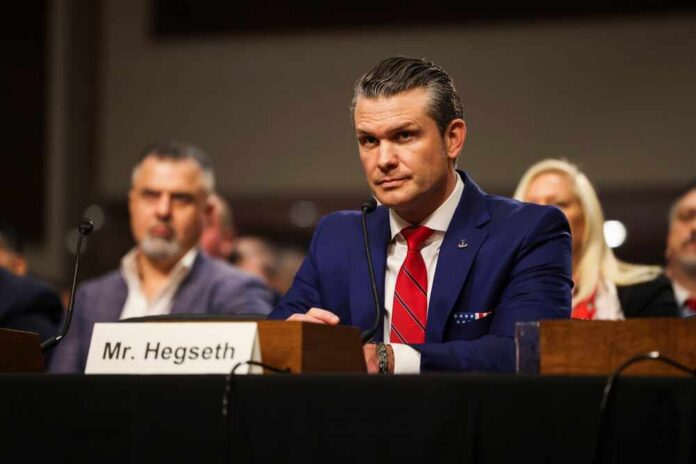
United States Secretary of War Pete Hegseth has made clear that current operations against Iran are designed to crush its ability to threaten American forces, partners, and interests far beyond its borders.[1][3] In a detailed briefing on Operation Epic Fury, he said U.S. forces are targeting Iran’s ballistic missiles, navy, and defense factories so Iran cannot easily rebuild its war machine.[1][3] He also stressed that the United States can restart large-scale combat at any time if Iran’s new leadership rejects a deal.[7]
In later briefings and speeches, Hegseth has repeated that the U.S. military is “more than capable” of resuming heavy strikes if talks stall.[5] He described over 7,000 Iranian targets hit so far, including air defenses and underground missile sites, as “overwhelming force applied with precision.”[3] At the same time, he claims Washington does not seek a regime-change war, even as he admits, “the regime sure did change” amid the campaign, a message that sounds like deterrence and pressure at once.[4]
Blockade, Airstrikes, and the Message to Iran’s Remaining Leadership
Hegseth has paired his words with a sweeping naval blockade of Iran’s ports and coastline, enforced by U.S. forces with orders to board, seize, or fire on ships that break it.[7] He has warned that any vessel heading to or from Iranian ports must “turn around or prepare to be boarded,” underscoring that the United States will use force in Iran’s own waters.[7] This blockade, plus relentless strikes on missiles, drones, and shipyards, sends a clear signal that even senior Iranian decision makers are within reach if they keep resisting.[3][7]
This approach fits a long pattern where Washington uses public threats and visible military power to try to “deter” Iran without openly promising full-scale invasion. Analysts say deployments like the USS Abraham Lincoln carrier group are meant both to shield U.S. troops and to raise the psychological cost for Tehran if it escalates. Policy papers going back years argue that credible threats against “high-value targets,” including leadership and nuclear sites, are part of a coercive strategy to change Iran’s behavior.
Tehran’s Warnings of ‘Regional War’ and Retaliation
Iran’s leaders are answering those threats with warnings of their own. Supreme Leader Ali Khamenei has said any U.S. military entry into Iran will cause “irreparable damage” to America and could turn into a wider regional war. He insists Iran will not surrender under “imposed war or imposed peace,” framing U.S. pressure as an attack on national dignity. Iranian officials cast Washington’s public warnings as proof that American bases, ships, and allies are now fair targets in any clash.
Iran’s foreign minister Abbas Araghchi tells foreign diplomats that Iran is “prepared” for war, even as he says he prefers dialogue. He argues the best way to avoid war is to be ready to fight, so that U.S. leaders do not “miscalculate” again. Iran’s defense minister has also bragged about new ballistic missiles able to hit distant targets with high accuracy and resist jamming, promising to unleash “weapons that have not yet been used” if war is forced on Iran.
Shared Fears: Escalation, Elites, and Ordinary People Paying the Price
Strategists on both left and right have long warned that this kind of brinkmanship with Iran carries huge risks for regular people, even if it looks like smart deterrence on paper. Studies of earlier showdowns, like the strike that killed Qassem Soleimani, found that U.S. leaders talked about “deterrence,” but the real outcome was a mix of tit-for-tat attacks and deeper mistrust. Experts say confused signals and political point-scoring in both capitals make it hard to know whether each new strike brings peace closer or pushes the region toward a spiral.
For Americans watching gas prices rise and wars drag on, it can feel like the same elite game repeating itself: tough talk, secret plans, and trillions spent overseas while problems at home pile up.[6] Many conservatives see another foreign entanglement that could fuel debt, inflation, and higher energy costs; many liberals see a path to more civilian deaths, refugee flows, and backlash against the United States. Both sides increasingly suspect that the people making these life-and-death calls will be protected, while soldiers, workers, and families shoulder the cost.
Does ‘Leadership Not Safe’ Deterrence Make America Safer?
Deterrence theory says making Iran’s remaining leaders fear for their own safety should push them toward a deal and away from attacks on Americans. That is the logic behind pairing sanctions, blockades, and targeted strikes with explicit warnings from people like Hegseth that the United States can always “hit harder” and penetrate deeper.[1][3][5][7] Yet even pro-deterrence analysts admit that war with Iran would be costly, risky, and unlikely to achieve easy victory, especially if it spreads across the region and shocks the global economy.
For citizens on both the right and the left, the core question is simple: are these threats making a disastrous war less likely or more likely? The record so far is mixed, with some periods of calm but also repeated escalations and fresh crises. That uncertainty is why many Americans feel the system is broken. They see leaders in Washington and Tehran trading warnings about “maximum violence” while the people who would bleed and pay the bills have almost no say in whether this deadly game continues.[3]
Sources:
[1] Web – The Secretary of War Has a Warning for Iran’s Remaining Leadership
[3] Web – US–Iran–Israel War: ‘Enemy Is Unmasked,’ Says US Secretary Of War Pete …
[4] YouTube – Pete Hegseth Live | Secretary of War Issues ‘Maximum Violence’ Warning …
[5] Web – US–Iran–Israel War: ‘Enemy Is Unmasked,’ Says …
[6] YouTube – LIVE | Hegseth’s Big Iran Warning: US Military Can Resume Operations …
[7] YouTube – LIVE: Pete Hegseth holds Pentagon briefing on the Iran war