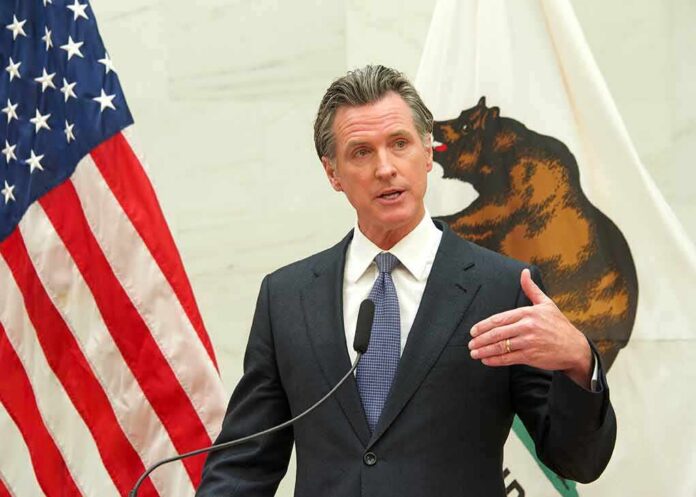
California Governor Gavin Newsom has wiped out every death sentence in the state at once, changing all 548 of them to life in prison without parole.
Story Snapshot
- Newsom commuted all 548 California death sentences to life without parole on November 5, 2026, the largest mass clemency of its kind in U.S. history.
- The move covers 529 men and 19 women on death row, but it does not repeal the death penalty itself.
- Some commutations still need approval from the California Supreme Court before they are final.
- Victims’ families, including Polly Klaas’s father, and several district attorneys have condemned the decision as unfair and rushed.
Newsom Orders Every Death Sentence Commuted
Governor Newsom announced his decision in an open letter to Californians, saying he used his “constitutional clemency authority to commute all California death sentences to life without the possibility of parole.” He wrote that the state cannot execute people “in our imperfect legal system and remain true to our core values,” pointing to justice and human decency as reasons for the change.
The order applies to every person on California’s death row, not select cases. Newsom’s letter names “the 548 people now under sentence of death in California” and states plainly, “I have decided to commute every death sentence.” News outlets confirm the total includes 529 men and 19 women.
Newsom first stopped executions in California back in March 2019. That earlier move paused executions but left death sentences standing. This new action goes much further, converting every sentence into life without parole, which Newsom’s letter calls “the most severe punishment I can lawfully impose”.
What The Order Does Not Change
Newsom’s letter makes clear this action “does not repeal the death penalty.” California’s capital punishment law stays on the books. Only the state legislature or voters can remove it entirely, meaning future governors could still seek new death sentences if circumstances allow.
The commutations are not fully locked in yet, either. Reports say California’s highest court must review some of the cases before they take effect, and legal challenges are possible. That leaves the policy announced but not entirely completed for every prisoner.
Newsom’s letter does not include a case-by-case review of guilt, innocence, or wrongdoing in each of the 548 cases. It lays out a broad moral and legal argument instead of individual findings for each prisoner.
Victims’ Families And Prosecutors Push Back
Marc Klaas, father of murdered 12-year-old Polly Klaas, called the decision a “knife in the back” to families who believe the sentences were lawfully handed down. Crime Victims United president Topo Padilla argued that “justice requires case-by-case consideration, not one-size-fits-all decisions,” saying Newsom never sat down with victims’ families before acting.
Los Angeles County District Attorney Nathan Hochman acknowledged Newsom’s legal right to commute sentences but questioned how the decision was reached. District attorneys in Fresno, Tulare, and Kern counties also condemned the move, saying it overrides the wishes of jurors and voters who originally upheld these death sentences.
A Broader Debate Over Error And Irreversible Punishment
Newsom’s reasoning connects to a well-documented national concern: wrongful convictions in death penalty cases. A peer-reviewed study of death sentences handed down between 1973 and 2004 estimated that at least 4.1% of those defendants would eventually be found innocent if their sentences had stood indefinitely. Researchers had already confirmed 117 exonerations by the time of that study.
That same research found something that matters here: people moved off death row and into ordinary life sentences get less legal scrutiny afterward, making future errors harder to catch. That tension sits at the center of this story. Supporters see commutation as removing an irreversible risk, while critics argue it removes accountability juries already decided case by case.
Legal experts note that governors using mass clemency powers on large groups, rather than reviewing cases one by one, has precedent elsewhere in the country. But the scale here, nearly the entire death row of the nation’s most populous state, makes this decision unlike anything attempted before.
What Happens Next
The California Supreme Court’s review will determine how quickly, and how completely, these commutations become permanent. Because the underlying death penalty law remains in place, the political fight over capital punishment in California is far from over. Newsom, term-limited and nearing the end of his time as governor, leaves behind a decision future leaders could still try to unwind.
548 DEATH SENTENCES. 😡
Gavin Newsom announced he is moving to convert every remaining death sentence in California to LIFE WITHOUT PAROLE. Many of those commutations still require California Supreme Court approval.
Want to know whose sentences he’s seek pic.twitter.com/a8aOHjEQrC
— CaptKyle Patriots Ⓡ 🍊 (@CaptKylePacsq) November 6, 2026
Whether Californians view this as a landmark correction of an error-prone system or a unilateral override of jury verdicts likely depends on which side of the debate they already stood on. What is certain is that the state’s death row, once holding 548 people, now holds none under active death sentences.
Sources:
time.com, bbc.com, nytimes.com, berkeleyside.org