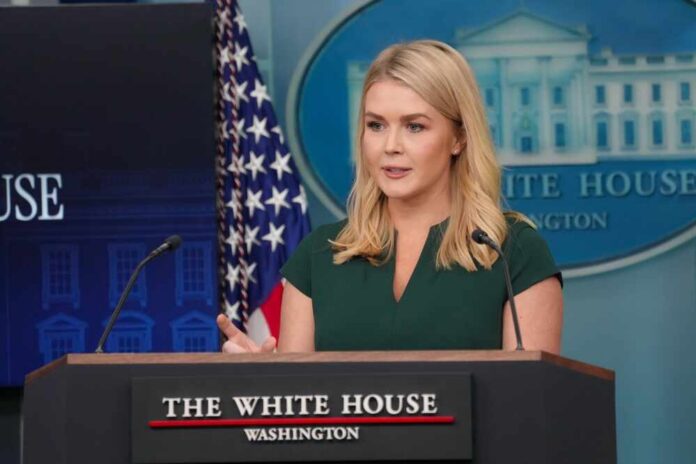
Operation Epic Fury is forcing a hard question inside Trump’s own coalition: how do you crush Iran’s threats without sliding into another open-ended Middle East war?
Story Snapshot
- White House Press Secretary Karoline Leavitt says Operation Epic Fury is “ahead of schedule” roughly 25 days into a stated 4–6 week timeline.
- The administration confirms indirect peace talks with Iran while rejecting media claims about a specific “15-point plan,” warning against anonymous-source reporting.
- U.S. objectives publicly emphasized include stopping Iran from obtaining nuclear weapons and degrading ballistic, naval, and broader defense capabilities.
- A pause on strikes against Iranian energy infrastructure and reported troop movements show the White House balancing military pressure with escalation control.
What the White House is saying about Operation Epic Fury
Karoline Leavitt’s briefing framed Operation Epic Fury as a defined, time-bound campaign that began in late February or early March and is now “ahead of schedule.” Leavitt pointed to progress claims such as Iranian naval capacity being severely reduced in key waters and reiterated the administration’s central objectives: deny Iran a nuclear weapon and destroy or degrade Iran’s ballistic, naval, and air-defense capabilities. The White House also described the operation as creating leverage for diplomacy.
Leavitt also pushed back on reports describing a detailed “15-point plan,” disputing the idea that any such specific package had been officially agreed to or disclosed. At the same time, she acknowledged that some elements being discussed publicly—especially preventing an Iranian nuclear weapon—overlap with what the administration says has always been the core mission. That mix of confirmation and denial is why many Americans are hearing “talks are real” but “details are guarded.”
Indirect talks, intermediaries, and the limits of public transparency
U.S.–Iran engagement is happening indirectly through intermediaries, including Pakistan and Turkey, while senior Trump-world figures are connected to the diplomatic track. The White House message has been disciplined: talks are underway, but leaks and anonymous-source reporting should not be treated as official terms. For voters who remember past intelligence failures and shifting narratives.
The administration’s operational timeline matters politically because President Trump campaigned on avoiding new wars, and many MAGA voters—especially older conservatives who lived through Iraq and Afghanistan—have little appetite for a long occupation or regime-change mission. The recent briefing does not show an announced plan for invasion or nation-building, but it does show widening military options, including troop movements described as giving the president flexibility. That “options” language is exactly what war-weary voters have learned to watch closely.
Military pressure versus escalation: the energy-strike pause and troop movements
A temporary pause—described as five days—on strikes against Iranian energy infrastructure, paired with continued force posture moves in the region. That combination signals two priorities operating at once: keep pressure on Iran’s military capabilities while limiting a shock that could spike global energy prices. For American families already angry about inflation and high costs after years of fiscal and energy-policy turmoil, avoiding a new oil shock is not a minor detail; it is central to domestic stability.
The operation’s claimed successes and the extent of Iranian capability degradation are largely presented through official briefings and aligned coverage rather than independent verification in the provided materials. The White House has argued the campaign is progressing quickly and effectively, but voters deciding whether this is a limited mission or the start of something bigger are being asked, again, to rely heavily on government messaging.
Where the conservative base is splitting: Israel, intervention, and constitutional skepticism
MAGA supporters are divided on deeper U.S. involvement and are increasingly vocal about how far America should go—even when the target is a regime long described as a sponsor of terrorism since 1979. Many conservatives strongly support Israel’s right to defend itself while also rejecting policies that could put U.S. troops into another generational conflict. That split is less about sympathy for Iran and more about mistrust of “mission creep.”
BREAKING: White House Press Secretary Karoline Leavitt says Iran will no longer have the ability to threaten the United States of America. pic.twitter.com/8qVZImtMJl
— Fox News (@FoxNews) March 30, 2026
Leavitt’s insistence that the mission is defined—paired with talk of negotiations—appears designed to reassure both hawks and skeptics. The unresolved issue for constitutional conservatives is oversight and clarity: Americans want to know what “victory” means, how long it lasts, what authorities are being used, and what obligations follow. The materials provided do not include those legal details, which is why the administration’s next briefings—and Congress’s posture—will matter for public trust.
Sources:
https://www.foxnews.com/video/6392158939112