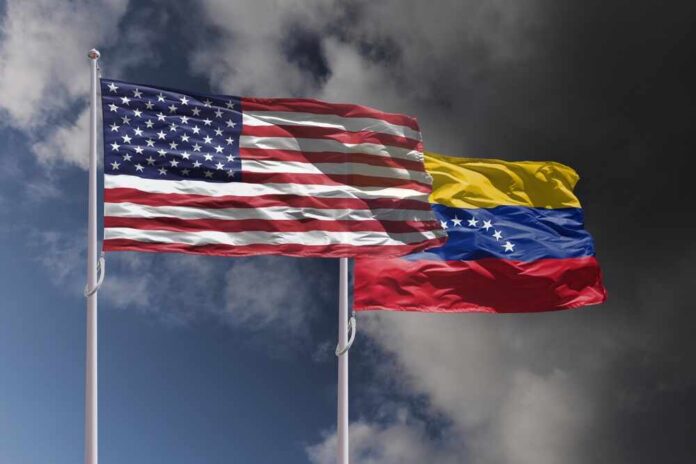
After a U.S.-backed regime change in Venezuela, Washington is moving at breakneck speed to plant the flag in Caracas again—raising hard questions for conservatives about who authorized what, and how long “temporary” foreign commitments really last.
Story Snapshot
- The U.S. Embassy in Caracas resumed operations ending a seven-year shutdown that began in 2019.
- The reopening follows a January 1 U.S. military operation that removed Nicolás Maduro and put him in U.S. custody, according to multiple reports.
- The Trump administration is using a phased approach, starting with limited duties while facilities are restored and staffing ramps up.
- Secretary of State Marco Rubio said the U.S. is moving quickly and described the mission as a “check” on Venezuela’s interim government, without giving an election timeline.
- Reports say Venezuela’s interim leadership agreed to U.S. access to oil and other resources, but public details on terms remain limited.
Flag Raised, Embassy Reopened—Fast
U.S. officials reopened the U.S. Embassy in Caracas on March 16, 2026, with the American flag raised over the compound for the first time since the diplomatic rupture in 2019. The administration framed the move as a rapid normalization after years of hostility and a security collapse that kept diplomats out. State Department planning described a phased restart, beginning with select duties and expanding as staffing and facilities allow.
State Department communications to Congress outlined how operations would restart while the embassy compound is brought back to a serviceable condition, including temporary facilities and rotating personnel. The Venezuela Affairs Unit, previously operating out of Bogotá, is shifting back to Caracas, a tangible signal that Washington intends a sustained, on-the-ground presence. For Americans watching federal power abroad, the speed matters: this is not a years-long thaw but a rapid rebuild.
What Changed: Maduro Removed, Interim Government Installed
Reporting across outlets ties the reopening directly to a U.S. military operation on January 1 that removed Venezuelan leader Nicolás Maduro from power and placed him in U.S. custody. In the aftermath, an interim government led by Delcy Rodríguez—identified as Maduro’s former vice president—took over and entered talks with the Trump administration. The basic sequence is widely reported, but the public record remains thin on governance details inside Venezuela.
Venezuelan officials publicly described the new diplomatic track as a joint schedule to address differences through dialogue, citing mutual respect and international law. U.S. officials emphasized speed and control: Rubio said the reopening would happen “very quickly,” and he indicated additional military action would require an imminent threat that the administration does not anticipate. That language suggests the White House views the situation as stabilized, at least for now.
Energy Interests Are Central—But Terms Are Still Murky
Venezuela’s oil wealth sits at the center of the strategic argument for engagement. Reports state that the interim government agreed to several U.S. demands, including granting U.S. access to Venezuela’s vast oil reserves and other natural resources. Interior Secretary Doug Burgum also spoke optimistically about investment flowing not only to offshore projects or Caracas but into resource-rich interior regions. What remains unclear is how any access is structured, and who benefits.
If energy access is part of the policy rationale, transparency on contracts, timelines, and enforcement matters—especially as American families still feel the sting of high prices and past fiscal mismanagement.
Constitutional Oversight and the Risk of Mission Creep
The administration notified Congress of its intent to reopen the embassy, reflecting at least some formal oversight channel for major diplomatic shifts. Still, the broader context—military action first, diplomatic normalization second—will intensify debate on Capitol Hill about war powers, executive authority, and whether the American people received a clear case for intervention.
JUST IN – US embassy resumes operations in Venezuela after seven years: State Dept
— Insider Paper (@TheInsiderPaper) March 30, 2026
For Venezuelan Americans, the embassy’s return is more immediate than geopolitical theory. Local reporting described renewed hope that visa services and family travel could resume after years of costly detours through third countries. That human impact is real, and it helps explain why normal consular functions matter. At the same time, conservatives who supported Trump to end the era of endless foreign entanglements will likely press for a defined end state in Venezuela—especially regarding security commitments.
Sources:
US appraises prospects of reopening its embassy in Venezuela
Trump Administration Reopens U.S. Embassy in Venezuela for the First Time Since 2019
US moves fast to reopen Venezuela embassy after yearslong freeze
U.S. representative arrives in Venezuela to reopen diplomatic mission after 7 years
Venezuelan Americans feel hopeful about US Embassy reopening in Caracas
Venezuela pushes to reopen its own embassy in the U.S.