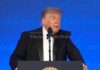
President Trump’s threat of a 100% tariff on French wine over France’s 3% digital tax spotlights how power politics can hit consumers while leaving core legal questions unanswered.
Story Snapshot
- Trump tied a 100% wine tariff threat to France’s 3% digital tax on large tech firms [1].
- The warning targeted President Emmanuel Macron and pressed for scrapping the levy [1].
- The tariff level echoes a prior United States Trade Representative discussion from 2019 [3].
- No primary legal ruling or official filing was provided in reports to justify retaliation [1][3].
What Sparked the Latest Tariff Threat
Reports said President Donald Trump warned France that the United States would impose a 100% tariff on French wine and champagne unless Paris ended its digital services tax. Coverage described the French measure as a 3% tax on revenue earned in France by large technology companies. The president linked the tariff threat directly to that levy and said he relayed the message to President Emmanuel Macron before the Group of Seven meeting [1]. The move aimed at pressuring France to remove the tax quickly rather than negotiate over time.
The 100% figure did not come out of thin air. Reporting noted the level tracks with ideas first raised by the United States Trade Representative during a 2019 probe into the French tax. Those earlier discussions explored steep duties on French goods if the tax harmed United States firms. The current warning revives that number and focuses pain on a marquee export with strong political clout in France. The goal is leverage, not just revenue, through targeted pressure on wine producers [3].
How This Fits a Wider Pattern of Digital-Tax Fights
Digital taxes try to capture money from large platforms that earn revenue in a country without a big physical presence. Governments argue these firms should pay more where users live. United States officials argue many of these taxes land hardest on American brands. That clash has sparked cycles of threats and talks. Wine, spirits, and luxury goods often end up in the crosshairs because they are iconic and politically sensitive in Europe, which increases pressure on leaders to strike a deal [3].
Past rhetoric also shows an escalation ladder. Reports recalled earlier moments when Trump floated even higher rates, including talk of 200% tariffs on French wines and other alcohol. Those signals built a backdrop where today’s 100% figure sounds tough yet familiar. For backers, that stance shows resolve. For critics, it looks like brinkmanship that drags businesses and shoppers into a fight over tax policy they did not set and cannot control [1].
The Evidence Gap: What We Know and What We Do Not
The core facts in public view rely on news write-ups and paraphrased quotes, not a posted White House transcript or a fresh legal filing. The available record does not include a new Section 301 determination, a formal tariff notice, or a public legal analysis proving that France’s tax discriminates against United States firms. Reports describe the tax, the rate, and the threat, but they do not supply the underlying documents that would show a rule-based case for retaliation now [1][3].
Trump Threatens 100% Tariff On French Wine Over Digital Services Tax Ahead Of G7 Summit https://t.co/tpyY8wvIdV pic.twitter.com/hXJJmpN1LH
— NDTV WORLD (@NDTVWORLD) June 15, 2026
This lack of visible paperwork matters. A 100% tariff would be extreme for many importers, restaurants, and consumers who buy French wine. Skeptics on the left and right will ask whether the cure fits the harm. Without a clear measure of the tax’s impact or a legal ruling, critics can call the threat coercion. Supporters can counter that France’s levy targets American companies by design. The dispute risks becoming a raw power test rather than a transparent policy debate [1].
What It Means for Americans, and Why Both Sides Should Care
Wine importers, small shops, and restaurants would feel the shock first if tariffs hit. Prices could jump. Some bottles could vanish from menus. That pain would not fall on tech giants or French tax writers. It would land on workers, owners, and customers here at home. Many Americans, right and left, already think the system shields the powerful while others pay the bill. A wine tariff tied to a tech-tax fight could harden that view and deepen distrust in government.
At the same time, many voters want fair play for American firms overseas. They do not want a patchwork of taxes aimed at United States companies. That concern is real. The clean way forward is sunlight and process. If the administration has a strong case, it can publish the legal basis, show the measured harm, and scale any response to that harm. If France believes its law is neutral, it can show the text, data, and effects across firms by country. Clarity would let citizens judge the tradeoffs.
Bottom Line: Leverage Without Clarity Raises Costs
Trump’s threat ties a clear demand to a clear target and leans on a familiar pressure point: French wine. The tactic may win talks in the short run. But without public evidence and a proportionate plan, the risk shifts to American buyers and small businesses that have no seat at the table. Transparency and restraint can protect both the national interest and the public. That is the standard many Americans expect and that both governments should meet [1][3].
Sources:
[1] Web – Trump threatens 100% tariff on French wines over digital tax
[3] YouTube – Champagne Problems: Trump threatens 200% tariffs on French wines