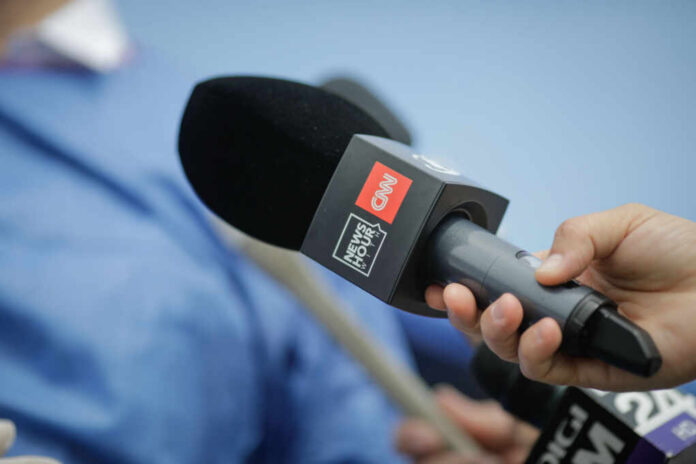
Cable news viewers are watching CNN’s medical commentators diagnose a sitting president’s routine checkup as a potential crisis — and critics say the network may have used a guest who stopped practicing medicine years ago to do it.
Story Snapshot
- CNN aired commentary suggesting President Trump’s venous insufficiency diagnosis could signal something more serious than a standard age-related condition.
- Sky News host James Morrow accused CNN of using a “fake doctor” to amplify the diagnosis, identifying the network’s on-air medical guest as Chris Pernell and alleging she had not practiced medicine since her residency.
- The underlying diagnosis — chronic venous insufficiency — is a real but commonly managed circulatory condition, and no clinical documentation in the public record confirms complications or functional impairment.
- The episode reflects a recurring media pattern where ambiguous presidential health updates become fuel for partisan speculation rather than straightforward medical reporting.
What the Diagnosis Actually Says
Trump’s medical team disclosed a diagnosis of venous insufficiency, a circulatory condition in which veins have difficulty returning blood from the legs to the heart. The condition is common among older adults and is generally manageable with lifestyle changes, compression garments, or minor medical intervention. The public record does not include a physician statement, clinical notes, or imaging results indicating that Trump’s case involves complications, hospitalization, or any functional limitation beyond the diagnosis itself. [1]
Without primary medical documentation — the kind that would come from an official White House physician’s letter or a formal health summary — any commentary asserting that the diagnosis points to a graver underlying condition is working beyond the available evidence. That gap between a real but limited diagnosis and the claims built on top of it is precisely where the controversy took root. [5]
The “Fake Doctor” Allegation and What It Means
Sky News host James Morrow said CNN brought on a guest identified as a doctor to “rev up claims” that Trump’s venous insufficiency was “somehow more serious than it might be.” Morrow named Chris Pernell as the commentator and alleged she had not practiced medicine since completing her residency. CNN has not issued a public correction based on available reporting, and no licensing records or credential documentation appear in the sourced material to independently verify or refute the allegation. [1]
The credential question matters for a specific reason: medical commentary on live television carries implicit authority. When a network presents someone as a doctor to assess a president’s health, viewers reasonably assume that person brings active clinical experience to the analysis. If that assumption is wrong, the commentary’s credibility collapses — and so does the network’s editorial judgment in booking the guest. The allegation alone, even unverified, was enough to generate a separate media criticism cycle that overshadowed the underlying health story. [1]
A Pattern Bigger Than One Segment
Trump’s health has been a persistent media flashpoint across both of his terms. The Daily Beast reported renewed speculation after Trump conducted a CNN interview entirely by text message, with some viewers demanding what they called “proof of life.” Prior coverage flagged swollen ankles and chronic venous insufficiency as potential indicators of decline. Each update, however modest, feeds a cycle in which audiences primed for either concealment or overreaction interpret the same facts in opposite directions. [5]
Donald Trump sparks new health fears as CNN expert points out 'unusual' symptomhttps://t.co/lZYOu5NpXz
— Irish Star US (@IrishStarUS) May 27, 2026
That cycle is not unique to Trump. Presidential health disclosures have historically been incomplete, and the press has historically filled the gaps with speculation. What has changed is the speed and intensity of the commentary ecosystem. A single on-air segment from a cable network can generate rival commentary segments, social media ridicule threads, and partisan counter-narratives within hours — all before any primary-source medical documentation is released or reviewed. The result is a public that is simultaneously oversaturated with health speculation and underserved by verified clinical information. [1] [5]
What Both Sides Should Be Asking
Conservatives are right to push back when a network presents contested credentials as authoritative expertise to build a politically convenient narrative. That is a legitimate press-criticism concern regardless of who is in the White House. But the pushback itself — routed through mockery and clip-driven outrage — does not resolve the underlying question of whether the diagnosis warrants any concern. Ridicule is not a medical assessment either. [1]
Liberals who want rigorous health accountability from any president are also right that a diagnosis deserves honest coverage. The problem is that honest coverage requires the original transcript, verified credentials, and actual clinical documentation — none of which have been fully produced in the public record here. Until those materials are available, both the alarm and the dismissal are operating on incomplete information. The American public deserves better from its media institutions than a race to the most emotionally satisfying framing. [1] [5]
Sources:
[1] YouTube – CNN hilariously busted for using fake doctor to smear Trump during …
[5] Web – Trump’s Texts to CNN Host Renew Health Speculation