A federal jury’s guilty verdict ties a deadly Los Angeles wildfire to one man’s actions, after prosecutors narrowed the case and convinced a second jury where the first could not.
Story Snapshot
- A federal jury convicted Jonathan Rinderknecht on two arson-related counts in Los Angeles.
- Prosecutors said a small New Year’s Day blaze smoldered underground and flared a week later as the Palisades Fire.
- Cell-phone data and fire-camera images underpinned the government’s timeline, despite no eyewitness to ignition.
- A prior jury deadlocked after the defense argued fireworks and insufficient proof, but the retrial ended in conviction.
What The Jury Decided And Why It Matters
Federal prosecutors secured convictions against Jonathan Rinderknecht for destruction of property by fire and arson affecting property used in interstate commerce. The United States Attorney’s Office for the Central District of California said the jury returned guilty verdicts after a retrial in November 2026. These are serious federal felonies. They reflect the jury’s view that the government proved its case beyond a reasonable doubt. The verdict caps a year of legal fights after a mistrial in June left the case unresolved.
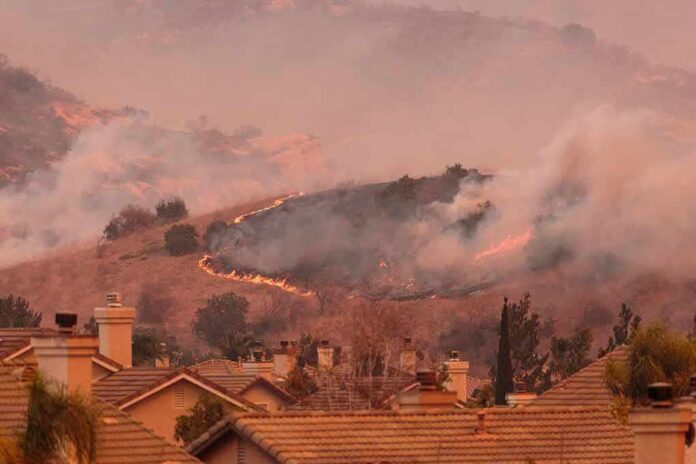
Prosecutors argued that Rinderknecht set a small fire near Pacific Palisades before dawn on January 1, 2025. They said that blaze, called the Lachman Fire, burned in roots and soil for days. Then strong winds helped it flare into the deadly Palisades Fire on January 7. The Department of Justice case page sets out that timeline and says he “maliciously started” the initial fire. The case connected a single spark to a disaster that killed 12 people and destroyed homes.
The Evidence The Government Leaned On
Investigators from the Bureau of Alcohol, Tobacco, Firearms and Explosives focused on phone-location records and recorded calls. An agent testified that Rinderknecht’s phone pinged near the ignition area when he tried to call 911, undercutting parts of his story to agents about where he had been. The agent said his account was inconsistent with the call locations. A University of California San Diego trail camera also showed fire activity about five miles away during a key time window.
The prosecution streamlined its case for the retrial. After the mistrial, the government dropped a timber-fire count and moved ahead on two revised charges. That step narrowed the legal issues, focused the elements to prove, and avoided a side dispute over a separate statute. The United States Attorney’s Office confirms the two counts that went to the second jury under federal arson laws and interstate commerce. The tighter case likely helped jurors track the timeline and evidence more clearly.
What The Defense Argued And What Remains Contested
The defense said fireworks from New Year’s celebrations likely caused the first fire. Their wildfire consultant, Tom Guzman, told jurors that the most likely cause was fireworks, and he said there was no physical proof to support the government’s cause theory. Defense counsel also stressed there was no direct eyewitness or a recovered ignition device proving intent. These points helped the first jury deadlock, showing the evidence was not simple to weigh.
Coverage of the first trial reported that many jurors leaned toward acquittal, saying there were holes in the timeline and no proof that embers survived for a week to spark the larger blaze. One juror argued that even if Rinderknecht started the first fire, he should not be blamed for the entire disaster because other failures played a role. The retrial verdict now stands. But those questions explain why people still debate how to assign moral and financial blame for the wider losses.
Why This Case Hits A Nerve For Voters On Both Sides
Californians watched another fire turn neighborhoods into ash. Many feel the system punishes late, argues over details, and still fails to prevent the next tragedy. The retrial shows the government can deliver a conviction after adjusting its case. Yet people on the left and right share doubts about how power works. Some see focused prosecutions while deeper problems—fuel loads, aging grids, housing in fire zones, weak oversight—go unfixed year after year.
*🚨 JUST IN: Man Convicted of Starting Deadly Palisades Fire After First Jury Leaned Toward Acquittal*
A federal jury has found Jonathan Rinderknecht, 30, guilty of deliberately starting the devastating Palisades Fire in Los Angeles, which killed 12 people, destroyed 6,845… pic.twitter.com/ITaMG1M38C
— (((IsraelMatzav))) (@IsraelMatzav) November 21, 2026
The legal outcome is clear: a federal jury found Rinderknecht guilty on two counts. The science and policy debates are not. The public still wants independent testing of the underground-smolder theory and full access to the technical record. That is reasonable. Courts settle charges. They do not answer every cause-and-effect question. Publishing the full reports, camera files, and methods could rebuild trust and help communities learn the right lessons before the next red flag wind event.
Sources:
irishtimes.com, nbcdfw.com, timesunion.com, cbsnews.com, latimes.com, justice.gov, laist.com