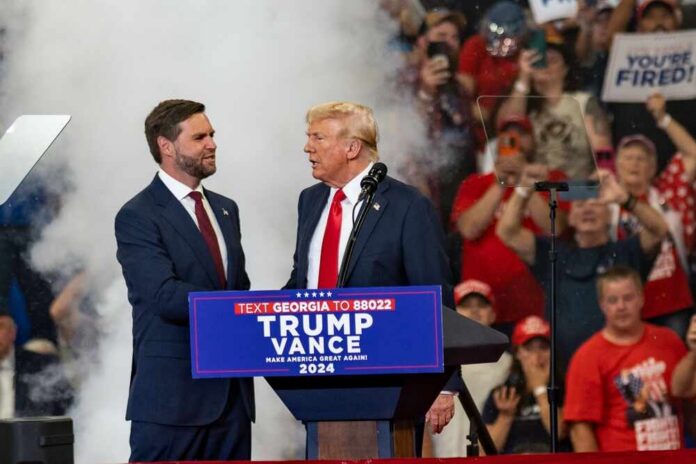
Vice President JD Vance now commands sweeping fraud investigation powers from inside the White House, shattering post-Watergate safeguards that kept presidents at arm’s length from law enforcement and raising alarm bells about politically-driven prosecutions targeting blue states.
Story Highlights
- Trump formally appointed Vance as “Fraud Czar” via executive order, directing a multi-agency task force from the White House rather than through traditional DOJ channels
- New Assistant Attorney General position will operate under White House oversight, breaking decades-old norms established after Watergate to protect DOJ independence
- Task force targets states like Minnesota, California, New York, and Maine with heightened scrutiny over Medicaid and welfare fraud, particularly cases linked to immigration
- No arrests announced yet, but Attorney General Pam Bondi warns prosecutions are imminent while critics accuse the administration of ignoring corruption within Trump’s own circle
White House Takes Control of Federal Fraud Enforcement
President Trump signed an executive order on March 16, 2026, establishing Vice President JD Vance as head of a new federal fraud task force operating directly from the White House. The initiative creates a high-ranking Assistant Attorney General position specifically for national fraud enforcement, coordinated through the Executive Office rather than traditional Justice Department structures. Vance announced the position will target organized fraud schemes across government programs, benefits, businesses, and individual citizens. This arrangement marks a significant departure from post-Watergate reforms designed to insulate law enforcement from direct presidential influence.
Targeting Blue States and Immigration-Linked Fraud
Trump’s February 24 State of the Union address launched the “war on fraud,” specifically highlighting Minnesota fraud cases involving Somali communities and connecting them to border security failures. The task force concentrates resources on Minnesota, California, New York, and Maine—states identified by the Centers for Medicare and Medicaid Services as high-fraud areas. CMS Administrator Mehmet Oz appeared alongside Vance at a February 25 press conference, endorsing the Vice President’s coordination of health care fraud efforts. Representative Paul Tonko criticized the approach during recent hearings, calling it “just playing politics” and questioning whether data or rhetoric drives state selections.
Budget Balancing Through Fraud Recovery
Trump claims the fraud recovery initiative will help balance the federal budget by reclaiming stolen taxpayer dollars from welfare schemes, Medicaid fraud, and business scams. The administration positions the effort as expanding beyond existing DOJ Fraud Section capabilities, which already handle opioid and pandemic-related prosecutions. Attorney General Pam Bondi pledged the Justice Department stands ready to prosecute offenders, warning fraudsters not to test the administration’s resolve. However, no specific dollar amounts recovered or arrests made have been announced since the March 16 executive order formalized the task force. Critics note the irony of focusing on government program fraud while allegedly overlooking potential corruption issues closer to the administration itself.
Constitutional Concerns Over Executive Overreach
The structure of Vance’s fraud czar role raises significant questions about constitutional separation of powers and prosecutorial independence. Post-Watergate reforms deliberately created distance between the White House and Justice Department investigations to prevent political interference with law enforcement decisions. Vance’s direct supervision of an Assistant Attorney General from the White House reverses these protections, giving the Executive Office unprecedented control over federal fraud prosecutions. Democrats accuse the administration of hypocrisy, arguing the task force ignores self-dealing allegations within Trump’s circle while aggressively pursuing cases in Democratic-leaning states. The arrangement consolidates power in ways that undermine constitutional checks and balances, a concern that should resonate with conservatives who value limited government and protection against federal overreach.
The long-term implications extend beyond individual fraud cases to the fundamental relationship between executive authority and independent law enforcement. While recovering stolen taxpayer funds serves legitimate government interests, the mechanism chosen threatens principles that protect all Americans from politically-motivated prosecutions. Vance embraced the “Fraud Czar” nickname despite its pejorative origins, signaling the administration’s willingness to consolidate enforcement power regardless of traditional norms. The task force’s interagency coordination involves DOJ, CMS, and other federal agencies realigning their fraud efforts under White House direction, fundamentally restructuring how federal law enforcement operates. This represents exactly the type of centralized federal power expansion that concerned citizens should scrutinize, regardless of stated objectives about combating waste and abuse.
Sources:
Trump names VP JD Vance ‘fraud czar’: What the role means and why it’s controversial
Fraud Czar Vance Will Have His Hands Full with Rampant Corruption in Trump White House