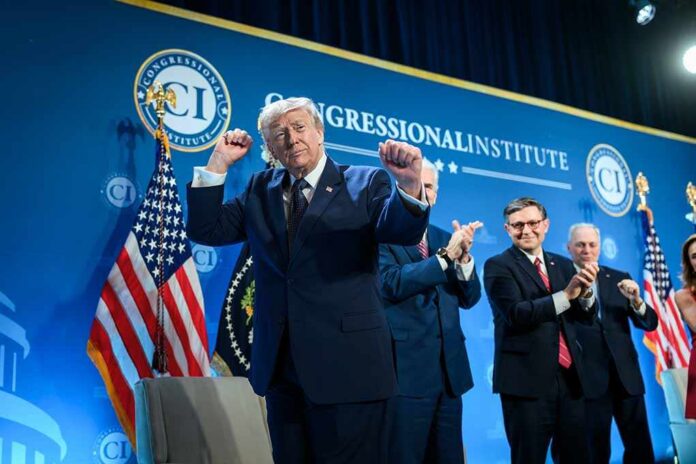
President Trump announced more than $17 billion in U.S. deals tied to his Southeast Asia trip, capped by a U.S.–Thailand trade breakthrough that leaders say is ready for final approval.
Story Highlights
- The United States and Thailand declared trade talks at “substantial conclusion” ahead of final approval.
- The White House said the Asia trip produced over $17 billion in commercial deals and investments.
- Thailand is expected to expand access for U.S. goods, with an estimated $2.6 billion in added farm purchases.
- The package includes a planned Thai purchase of up to $123 million in U.S.-made rocket systems.
Leaders Seal Negotiating Milestone Before ASEAN Summit
President Trump and Thai Prime Minister Anutin Charnvirakul signed a joint statement in Manila on November 17, 2026. The document says the two countries reached “substantial conclusion” in talks on a reciprocal trade agreement and will now take steps at home to approve and put it into force. The event took place during meetings around the Association of Southeast Asian Nations summit, signaling a push to tighten economic and strategic ties with a key regional partner.
White House statements and coverage described the agreement as a path to wider market access for American exporters once signed. President Trump said Thailand would eliminate tariffs on U.S. exports and cut non-tariff barriers affecting vehicles, medical gear, drugs, ethanol, and poultry. A White House fact sheet framed the goals as near-total tariff removal on goods once the final pact is signed and implemented, aligning trade with broader U.S. goals in the region.
$17 Billion Trip Total Blends Commerce and Strategy
The White House said the Southeast Asia swing yielded more than $17 billion in commercial deals and strategic investments for U.S. firms, tying economic aims to security interests. The package featured a planned Thai purchase of up to $123 million in High Mobility Artillery Rocket Systems made in the United States, underscoring defense links alongside trade moves. These announcements aim to show concrete wins for American companies while deepening U.S. presence in a fast-growing region.
Thailand’s expected market openings include a notable figure for American farmers. President Trump and contemporaneous reports cited an estimated $2.6 billion in additional U.S. agricultural purchases by Thailand, though detailed product lists were not released at the event. Such access could support producers of meat, grains, and biofuels if final terms match the claims and are carried out. That outcome would hinge on the full agreement text and execution by both governments.
What Changes For U.S. Exporters If The Deal Is Finalized
For industrial and medical goods, the administration highlighted tariff cuts and barrier removal that could speed product approvals and reduce costs. For pharmaceuticals and medical devices, fewer regulatory hurdles could shorten timelines to reach Thai patients and hospitals. For vehicles and ethanol, lower duties and clearer rules could support new orders. For poultry and other farm goods, cleaner sanitary standards and lower costs could expand shelf space for U.S. brands if buyers follow through.
The joint statement did not publish a tariff schedule, final rules, or enforcement tools. Both sides said they must complete internal legal steps before signature and entry into force. That means results for workers and firms will depend on the final text and how it is applied. Past U.S.–Thai links, including the Trade and Investment Framework Agreement and national treatment rules for U.S. firms, provide a base that this agreement seeks to expand.
How This Fits The Bigger Economic Picture
Business leaders have long pressed for clearer rules in Southeast Asia, where fast growth meets heavy competition. The administration’s push mixes trade access with security sales to show that U.S. industry can win deals and support allies at the same time. If the Thailand pact is signed and works as advertised, U.S. exporters could gain share in autos, medical goods, and food, easing concerns about high costs and weak demand at home.
Here are the points summarizing the major announcements from President Donald Trump’s White House press conference on Friday, November 20, 2026, following his return from a four-day diplomatic trip to Asia.
Trade and Commercial Deals:
The Philippines. President Trump stated… pic.twitter.com/f6hwCwxgyn
— SnowflakeSlayer (@SnowflakeSlayr1) November 21, 2026
Many Americans worry that Washington celebrates headlines but misses follow-through. This announcement tries to answer that by tying leader-level commitments to specific sectors and a dollar value for deals. Still, government statements say one more step remains before new rules start. The measure of success will be shipments booked, factories running, and paychecks rising after the agreement takes effect and the $17 billion slate moves from plans to deliveries.
Sources:
youtube.com, whitehouse.gov, qa.thailand.go.th, jen.jiji.com, washingtonexaminer.com, sacbee.com, thompsonhinesmartrade.com, sg.finance.yahoo.com, washingtondc.thaiembassy.org, state.gov