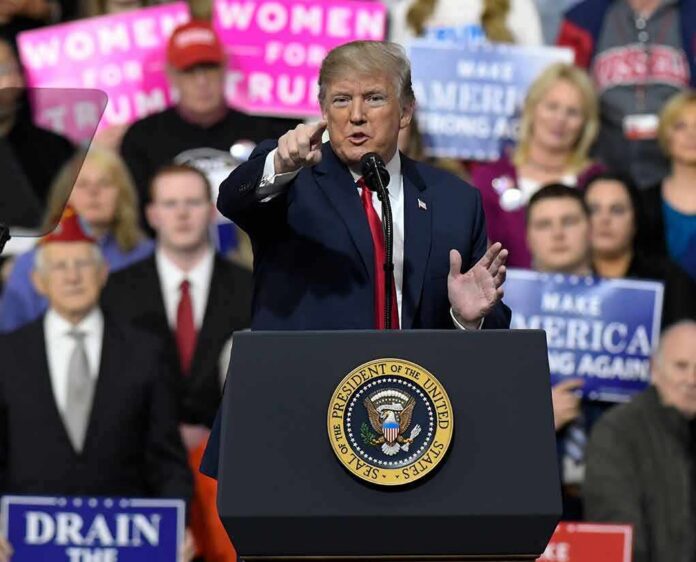
President Trump stood inside a General Motors testing facility in Michigan to make his case that trade deals he championed saved American manufacturing jobs, even as protesters and hecklers tried to drown him out.
Quick Take
- Trump spoke at GM’s Milford Proving Ground, focusing on manufacturing, auto jobs, and the economy ahead of Michigan’s primary.
- The visit continues a years-long pattern of Trump using Michigan factory floors and industrial venues to push his trade message.
- Hecklers and protesters interrupted the speech, drawing loud pushback from supporters in the crowd.
- News coverage confirms where Trump spoke and what he talked about, but does not independently verify his economic claims.
- Michigan remains a top battleground where both parties fight hard over the manufacturing vote.
Trump Returns To A Familiar Michigan Stage
Trump traveled to Milford, Michigan, ahead of the state’s primary to highlight manufacturing and auto industry jobs. He delivered his speech at General Motors’ Milford Proving Ground, a facility where the automaker tests new vehicles. The location was no accident. It let Trump stand near cars and machinery while talking about factory work, jobs, and the economy.
This is not new ground for Trump in Michigan. He has held rallies, town halls, and roundtables across the state for years, often picking sites tied to industry and manufacturing. Past stops include a production plant in Walker, a community college in Warren, and an airport hangar in Waterford. The pattern shows a campaign strategy built around blue-collar imagery.
Why Michigan Keeps Getting The Spotlight
Michigan is both a swing state and a manufacturing hub, which makes it useful for political messaging on trade. Candidates from both parties use factory backdrops to claim credit for job growth, whether or not the numbers back up the message. That mix of symbolism and substance is why Trump keeps returning to auto plants and industrial parks instead of generic rally halls.
Trump has pushed tariffs and trade deals as tools to bring back manufacturing work to states like Michigan. Reporters have consistently described his visits as chances to spotlight the auto industry and jobs, but the coverage available does not include hard data proving those policies caused specific gains. That gap matters for voters trying to judge the claim on facts alone.
Protests And Heckling Overshadow Parts Of The Speech
Not everyone in the room agreed with Trump’s message. Video from the event shows a heckler shouting accusations during his remarks on the auto industry, prompting a sharp response from the crowd. Other footage shows data center protesters interrupting a separate portion of his Michigan speech, forcing security to step in while Trump kept talking.
🔥 Some degenerate just tried HECKLING President Trump during his speech in Michigan, so patriots in the venue DROWNED THE GUY OUT by chanting "USA! USA!"
POTUS: "He's a COMMUNIST. We're running against COMMUNISTS!"
I was waiting for the "go home to Mommy!" 🤣…
— Dave Hayes (@praying_medic1) July 28, 2026
Democratic leaders in Washington used the moment to attack Trump’s economic message directly. Senate Minority Leader Chuck Schumer criticized the speech, arguing Trump was bragging about numbers that do not reflect what everyday families feel at the grocery store or gas pump. That kind of pushback shows how the same event can be read two very different ways depending on political priors.
What The Record Actually Shows
Available reporting confirms the venue, the timing, and the general theme of Trump’s remarks. It does not include a full transcript proving his specific claims about trade deals reviving Michigan manufacturing, nor does it include labor data, plant output figures, or wage numbers that would settle the debate one way or the other. That absence leaves plenty of room for spin on both sides.
Voters frustrated with Washington, whether they lean left or right, share a common complaint: politicians talk about jobs and factories without always backing it up with proof. Trump’s Michigan stop fits that broader pattern. The speech generated headlines and heated moments, but the deeper question of whether trade policy truly changed manufacturing outcomes in Michigan remains unresolved in the public record.
As Michigan’s primary approaches, expect more visits like this one. The state’s mix of auto plants, union workers, and swing voters guarantees that both parties will keep showing up at factory gates. Whether those visits translate into real economic change, rather than just good campaign optics, is a question voters will have to keep asking past election day.